


This article is relevant if you know NetSuite contains the truth of your business, but you have doubted whether it could ever deliver the responsive, intuitive, and intelligence-driven experience your team needs to lead with confidence. Time to revisit the Make vs. Buy software crossroad.
TL;DR Summary
For years, we have demonstrated that NetSuite can drive far better user experiences than the standard interface suggests. We have built alternative grid-based applications, high-performance task and resource assignment tools, enhanced sublist-editing experiences, case-management alternatives, inline-editing patterns, and even NetSuite-driven Gantt applications. Those efforts proved that the platform was never the real limitation. The true constraint was the cost, time, and coordination required to design and deliver these experiences. Now, with modern AI-assisted development tools, that cost structure has changed materially. Skilled analysts who understand the business model can move from idea to working application in a fraction of the historical effort. The result is a more compelling make-versus-buy equation, renewed skepticism about unnecessary add-on products or separate data warehouses, and a powerful opportunity to deliver better managerial intelligence directly from NetSuite.
Background
At Prolecto, we have long held a consistent view: NetSuite is not merely a transactional back-office system; it is a malleable business platform capable of modeling and expressing meaningful operational truth. Back in 2022, we explicitly described the idea of unleashing the NetSuite user interface by innovating via the platform, showing that teams could bypass prescribed interface patterns while still leveraging NetSuite authentication, permissions, logic, and database structures. That article made a foundational point that still matters today: once you free yourself from how NetSuite wants to present information, a wider world opens for solving real business problems. See: Unleash NetSuite’s User Interface by Innovating via the Platform.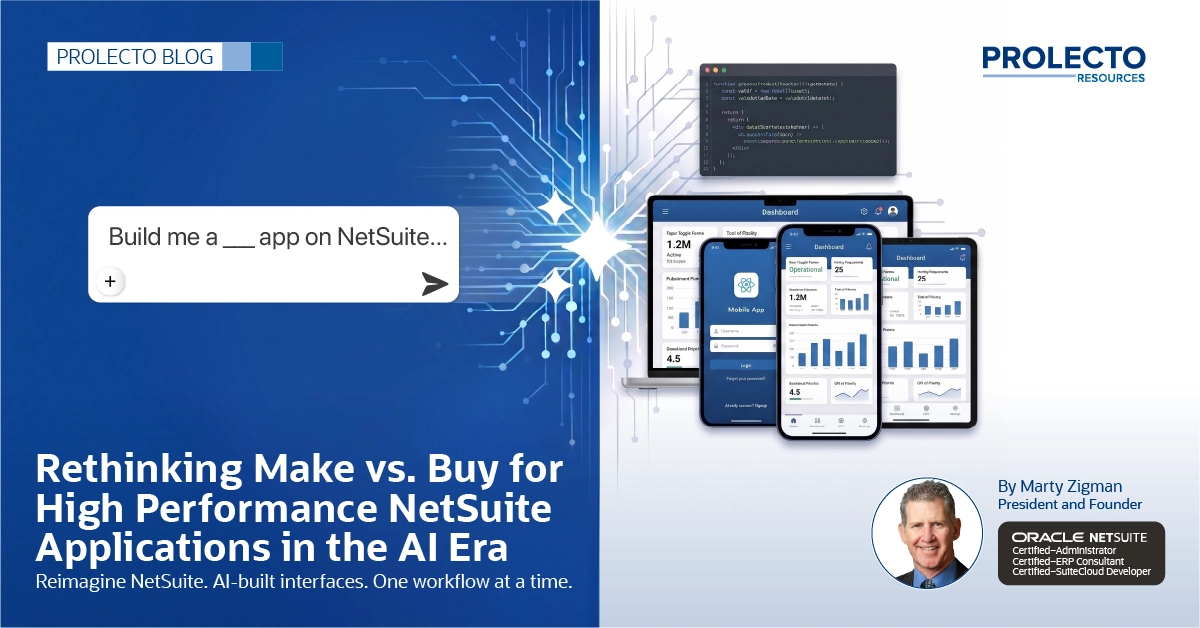
Since then, we have continued to show this pattern in increasingly focused use cases.
In August 2023, we demonstrated how to extend NetSuite sublists with high-performance edits when the standard extensibility model was too restrictive. The point was not simply technical cleverness; it was that important working surfaces inside NetSuite could be reshaped when native patterns fell short. See: Watch How to Extend NetSuite Sublist with High Performance Edits.
In November 2023, we shared a high-performance task and resource assignment solution built around NetSuite Advanced Projects and SRP. That article reflected our own long operating experience with SRP and reinforced the idea that serious project-centric organizations often need a more refined experience than the base application naturally provides. See: Get High Performance NetSuite Task and Resource Assignments.
In December 2023, we published a reimagined NetSuite case management experience, highlighting the opportunity to avoid additional cost and complexity from disconnected third-party case tools by crafting a more user-friendly NetSuite-centered interface. See: Revamping NetSuite Cases: a High-Performance, User-Friendly Experience.
In June 2024, we presented a high-performance alternative to NetSuite’s Grid Order Management for matrix-item businesses. Again, the message was clear: when native user experience patterns are too rigid, a NetSuite-driven alternative can be designed around how users actually think and work. See: See a High Performance Alternative to NetSuite’s Grid Order Management.
In April 2025, we introduced a NetSuite-driven high-performance Gantt application, demonstrating that even sophisticated visual planning and scheduling experiences can be delivered natively on the platform, without third-party hosting or recurring license fees for the framework or application. See: Get a NetSuite-Driven High-Performance Gantt Application.
Most recently, in January 2026, we published an alternative approach to NetSuite inline edits through InlineEditorQL within the PRI Extensible Client Framework. That work underscored how SQL-driven interaction models can provide business analysts and functional leaders with more powerful ways to review, control, and transform data than saved searches and standard inline edits usually permit. See: Supercharge NetSuite Inline Edits Using an Alternative Approach.
Taken together, these articles show that we have been in the game for years. They also prove an important historical truth: the NetSuite platform has long supported superior user experiences. However, there has always been a practical barrier; the effort to conceive, coordinate, and deliver these solutions was significant. That is the assumption now being challenged.
NetSuite User Interface Innovation Has Entered a New Era
The real breakthrough is not that better NetSuite user experiences are possible. We already knew that. The breakthrough is that the effort required to create them is collapsing.
Historically, delivering a transformative application required substantial business analysis, technical design, leadership oversight, handoffs, testing, refinement, and the coordination costs that come from multiple people having to share one vision. Even when the business case was strong, many ideas were deferred because the cost to overcome user experience friction simply felt too high.
In our own firm, we know this dynamic intimately. We use NetSuite SRP (Advanced Projects) as part of our operating environment. We avoided NetSuite’s user interface as too slow and clunky. In a prior major internal application effort, I invested 80 hours of my time as an analyst and 230 hours of a technical analyst to bring forth a high-performance management application that our leaders use daily to stay on top of client commitments.
It was a good investment. We gained complete control over the outcome. Yet, naturally, refinements still had to wait behind other priorities, and the instinct was to rely on the original contributors for future changes.
Now consider what happened next.
While working with the latest AI large language model tools, we began to see a different path. One of our managers in our Operations Practice, Mathieu Laporte, decided to use personal time during a family holiday to learn this new mode of software creation. He uses our custom NetSuite SRP system, as all of our managers do. Yet, rather than merely considering editing the existing application, he started over. He reimagined how he wanted the management process to feel, what signals mattered most, and how information should be expressed for day-to-day leadership.
The result was striking. In about 1/10th the time, or in about 20 hours, including roughly 5 hours spent learning the new creative process, he produced a compelling alternative management application. More importantly, this was not an isolated mockup. It expressed a broader pattern. In a short period thereafter, he created a set of focused client applications that explored variance analysis, revenue sprint concepts, pipeline service revenue and transaction chaining for late fee audit logic. We are so enthusiastic that we internally deployed his new alternative to our SRP management. These efforts illustrated that the old economic assumptions no longer hold in the same way.
Watch the Discussion on Breakthrough AI-Driven Applications
Listen to Marty Zigman and Matthew Laporte explain how AI is transforming NetSuite into a more intelligent operational platform.
Click on images to get a feel of the applications generated from the new capacities offered by AI-Assisted design and development.
NetSuite as the Foundation for Transformative User Experiences
This is where the story becomes especially relevant for the broader NetSuite community.
Many organizations still carry assumptions formed in an earlier era. They assume the native interface defines the practical ceiling. They assume a better experience requires an add-on product. They assume management intelligence must be pushed into a separate warehouse. They assume CRM dissatisfaction or reporting frustration implies that NetSuite itself is the wrong base.
Those assumptions deserve fresh scrutiny.
The NetSuite platform continues to provide the guardrails that matter. Authentication, permissions, transaction structures, auditability, and accounting controls remain central strengths. Debits still must equal credits. Core business logic still lives in one governed system of record. But the user experience layer around those controls can now be shaped much more freely and much more affordably than before.
That means organizations can think differently about transforming data into information and information into intelligence. In truth, many initiatives never made it to the intelligence layer because the cost of creating a suitable interface was too high. Today, the near-zero marginal cost of producing actual software logic through AI-assisted methods invites more experimentation, more versions, and more learning. Analysts can explore possibilities that previously would have been rejected before they ever reached a whiteboard.
This also changes how we evaluate make versus buy. Purchasing software may still be the right decision in many cases. But Make is now far more competitive when the desired solution depends on your unique business logic, your leadership workflows, your operational timing, and your specific need for integrated truth. The more distinctive the requirement, the more interesting NetSuite-centered application design becomes.
A Practical Approach to AI-Augmented NetSuite Application Design
The right lesson is not that every company should custom-build everything. The right lesson is that business leaders should revisit which problems are now economically solvable.
A useful approach includes the following elements:
- Start with the business actor: Design around the person responsible for decisions. A project manager, revenue leader, service coordinator, controller, or customer service representative each needs a different expression of truth.
- Keep NetSuite as the operational control center: The objective is not to abandon the platform; it is to exploit its data model, permissions, and governance while shaping a more effective working experience around them.
- Validate trust through tie-out logic: Better interfaces are only useful if they can be trusted. Variance analysis, revenue views, chain audits, and other managerial applications must reconcile to the underlying financial and operational records.
- Encourage focused experimentation: Multiple versions are now practical. Teams no longer need to assume there is one expensive attempt to get the interface right.
- Use AI to reduce friction, not discipline: Lower development cost does not remove the need for repositories, security practices, documentation, change control, and maintainability thinking.
What Mathieu’s Journey Illustrates
Mathieu’s work demonstrates a new type of analyst leverage. He understood the data model, the business logic, and the team’s practical leadership needs. With concentrated effort and AI assistance, he could work through ideas without the historical cost of translating every concept through traditional coding layers or extended collaborative handoffs.
That matters because focus is often what organizations lack. When we are too busy, we do not always create space for genius. Yet once an analyst can sit with the challenge, shape the vision, and use the machine as a willing technical companion, creativity expands. Problems once avoided because they seemed too expensive can now become reasonable candidates for direct solution.
The Setup
- Model the management question first: Identify the operational decision that needs better visibility before deciding what records, screens, or charts should exist.
- Design for speed and clarity: The strongest applications reduce cognitive load and make relationships visible without forcing users through awkward native patterns.
- Preserve platform integrity: Every enhanced interface should still respect NetSuite permissions, logic, and financial governance.
Key Considerations to Activate
- Challenge the Data Warehouse assumption: Some reporting and intelligence needs may still warrant a data platform, but many can now be expressed directly from NetSuite with a purpose-built application layer.
- Rethink the NetSuite CRM question: In many cases, the real weakness is not the underlying data model; it is the user experience built around it. With today’s tools, we can create fast, intuitive, and pleasing NetSuite-centered interfaces that may remove the need to look for another CRM system.
- Value the analyst’s mind more than the tool: These new methods amplify good thinking, but they do not replace business modeling capability.
- Treat maintenance as a design responsibility: Rapid creation is powerful, but long-term value still comes from secure, understandable, and supportable solutions.
Leading with Precision, Imagination, and Practical Skill
What excites us most is not simply that software can now be produced faster. It is that more organizations can afford to imagine better operating realities. User interface weaknesses should no longer be accepted as a permanent excuse. NetSuite-driven business applications can be shaped for the key actors who lead the organization. What was once too demanding relative to the expected investment is now becoming practical.
This direction also fits Prolecto’s long-standing philosophy. We believe in listening deeply, modeling business challenges accurately, and translating those models into durable operating systems. We believe clients should benefit from the intellectual property, algorithms, and design patterns that emerge from our work without being trapped in unnecessary license structures (see our Labs initiative). And we believe that excellence comes from a combination of practical wisdom, technical depth, and care for the client’s long-term interests. Those principles have animated our prior user interface innovations, and they become even more powerful in an era where AI helps compress the cost of execution.
The opportunity before the NetSuite community is straightforward: rethink the boundary between the platform you have and the experience you wish you had. That boundary has moved.
If you found this article relevant, feel free to sign up for notifications to new articles as I post them. If you are ready to rethink what is possible with NetSuite-driven user experiences and AI-augmented application delivery, let’s have a conversation.