


This article is relevant if your organization manages customer commitments (e.g., sales orders) that change over time and you need a disciplined way to control financial impact, approvals, fulfillment implications, and customer communication inside NetSuite.
TL;DR Summary
Prolecto solved the core NetSuite change order control problem years ago by modeling change orders as a governed structure rather than forcing the problem into standard Estimate mechanics or modification of sales order lines. What is different now is the economics of the user-delivery experience. With AI-augmented development methods, we can place a far more intelligent and enjoyable working surface around that proven logic. The result is a decision-ready change order cockpit that helps teams compare original versus proposed commitments, assess financial and fulfillment impact, guide approvals, and communicate clearly with customers while preserving NetSuite as the governed source of truth.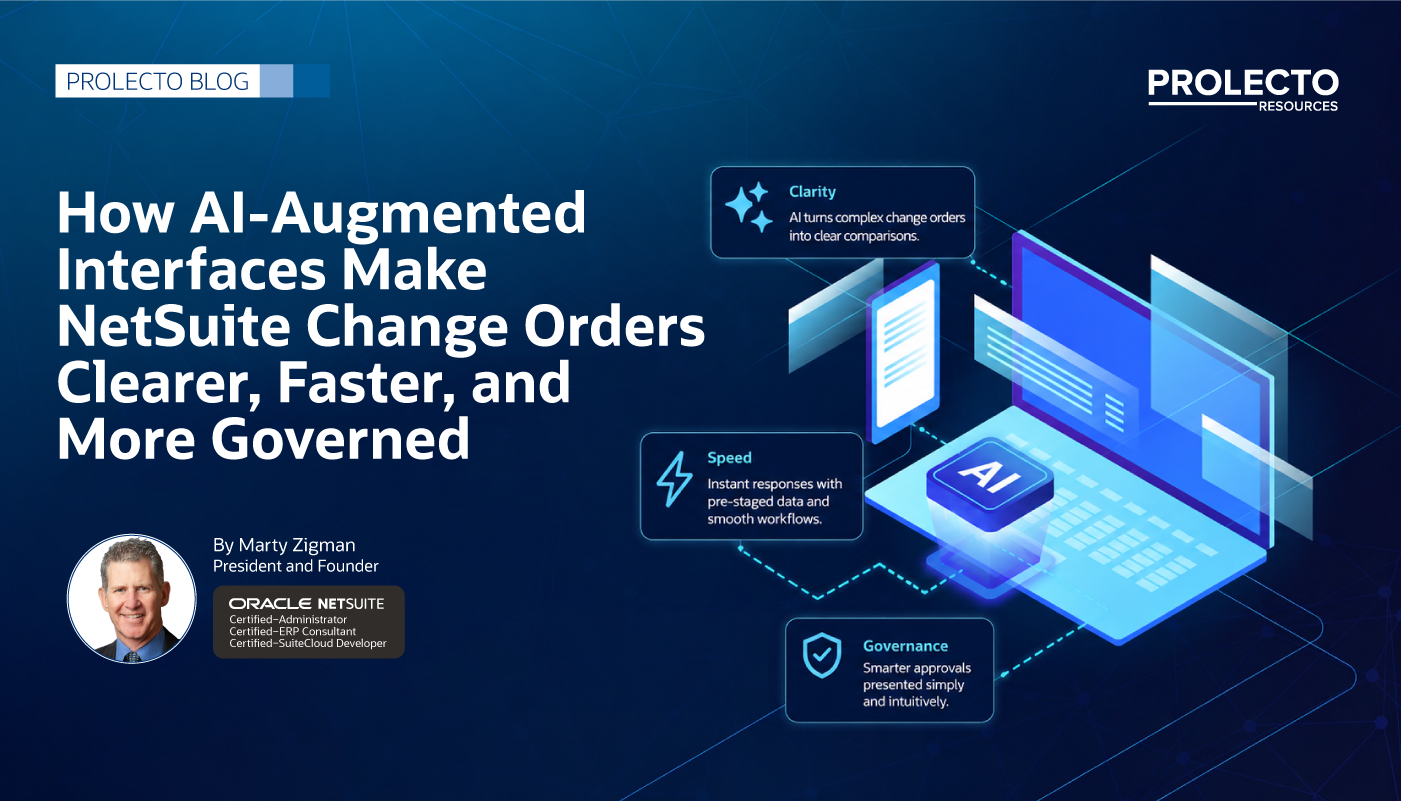
Background
In 2021, I described a NetSuite change order pattern for organizations dealing with long-running or complex customer commitments. The business problem was not theoretical. A customer approved one commercial arrangement expressed in a sales order, but over time, the customer’s situation changed. It may result in items added, quantities reduced and price changes. Perhaps delivery details and commercial terms require reconsideration.
The challenge was not just administrative. Customers needed budget control and a clear understanding of the change before they approved it. Internal teams needed discipline around adds, reductions, pricing, costs, approvals, and fulfillment implications. Accounting and operations could not afford ambiguity. This is what it really means to deal with Change Orders.
The key design insight remains true: a change order is not merely a new estimate. A real change order can produce a net positive or net negative result. It may need to reduce part of the original commitment where fulfillment has not occurred, while also creating a new commitment for additions. It must package the commercial effect in a way that customers and internal stakeholders can understand and approve.
That original breakthrough architecture gave the client a governed structure that mimicked the commercial behavior of a Sales Order while isolating the change process from the live transaction workspace. We could copy the original Sales Order into a dedicated change order structure, isolate quantity, price, cost, and header changes, summarize financial impact, produce customer-facing documents, route for customer approvals, generate new Sales Orders for additions, and properly handle reductions to the original order where appropriate.
Clients who implemented the pattern were satisfied. The business control logic was strong. While we didn’t give it much thought at the time, based on yesterday’s common sense, we accepted that the working surface for users was sufficient. How many of us settle for day-to-day situations because we think the effort to change them will be simply too high?
NetSuite Change Orders Need More Than Transaction Logic
Five years later, in 2026, old challenges are being reviewed again through a new lens. The governing logic does not need to be reinvented. It already reflects sound business modeling. What has changed is our ability to build a better user experience around that logic.
This is important because many NetSuite frustrations are not weaknesses of the platform itself. They are constraints offered by the default interaction layer. NetSuite can maintain the database truth, enforce prescribed business logic, hold permissions, preserve auditability, maintain transaction relationships, and uphold accounting integrity. Yet in complex operational scenarios, users do not always experience the standard interface as a natural place to think, compare, simulate, and decide.
For years, many of us tolerated that tradeoff because we valued integration, interconnection, and a seamless relationship to the larger NetSuite environment. That was a reasonable compromise. But, if we admitted it, especially with today’s emerging standard for usability, it was still a compromise.
Change orders are a perfect example. Users often need to try multiple what-if scenarios before deciding what should move forward. They need to compare the original and proposed commitments without disrupting the current order. They need to test the feasibility and understand the financial consequences without polluting the standard Sales Order workspace. We solved that challenge correctly. This is where good problem modeling pays dividends. Once the business logic is modeled correctly, the next opportunity is to create a skin that makes that logic joyful and meaningful to use.
A Better Approach: The NetSuite Change Order Decision Cockpit
The 2026 opportunity is to turn governed change order logic into a decision cockpit.
Instead of asking users to live with NetSuite’s loading speed and working layout, the application can present the relevant truth in one coherent, high-performance working surface.
The improved interface can be designed to:
- Compare original versus proposed commitments clearly: users should immediately see what was committed, what is changing, and what remains intact.
- Isolate deltas by line and header: quantity, pricing, cost, shipping, and commercial term changes should be explicit and easy to interpret.
- Expose financial impact in business language: the system should summarize revenue, cost, margin, and net commercial effect in a way managers can act on.
- Highlight fulfillment risk and operational timing: if reductions affect open commitments or additions require new commitments, the implications should be visible early.
- Guide approvals based on policy: manager approval rules can be introduced depending on the nature of the change, so that governance remains intact.
This is where AI-augmented development materially changes the economics. We solved the change order logic years ago; yet we expressed it in NetSuite’s narrow user interface terms. What is different now is that we can give the user a far more intelligent working surface around that logic.
Video Demonstrations: Before and After
In this case, the core system logic is shown in the short video below:
Click here to watch the core logic video directly
Click here to watch a demo on the enhanced user interface
Key Considerations Guiding High-Performance Change Order User Interfaces
- Make speed part of the design: users should see the interface immediately while background processes prepare default structures and supporting records. We must avoid NetSuite’s relatively slower form-loading experiences
- Use caching and pre-staged lookups where appropriate: high-frequency item and record access should feel immediate, not burdensome. We want immediate speed!
- Eliminate adoption friction: accept that when interfaces are slow or arduous, users work around them. That undermines the whole point of the effort. Better performance protects process integrity.
- Extend governance without complicating the experience; approval rules can become more sophisticated while the user experience becomes simpler and clearer.


Avoid NetSuite Add-Ons: Why This Reinforces the Make-Versus-Buy Thesis
This pattern is exactly why NetSuite-centered application design often outperforms generic add-ons. The business rules are highly specific. The commitments must remain governed. The data has to tie back to the NetSuite truth. The process needs role-aware experiences without sacrificing control. This change order improvement reinforces my point in my article, Rethinking Make vs. Buy for High Performance NetSuite Applications in the AI Era
All of this fits in our competitive business model where we give our clients all of our intellectual property without license fees or recurring costs. The point is not novelty. The point is an important philosophy that unlocks NetSuite’s potential and deepens the value we are getting from the NetSuite ERP investment.
AI does not replace the need for sound business modeling. It does not replace listening. It does not replace architectural discipline. What it does is compress the cost of expressing better thinking through software. That shift changes what is practical. We can now deliver richer, faster, more actor-specific applications at a fraction of the historical coordination and development effort.
NetSuite Craft Built for Serious Operators
This change order enhancement reflects a broader principle that matters to both clients and prospective talent. Great systems work begins with careful listening and honest modeling. Once the problem is understood properly, elegant execution becomes possible.
At Prolecto, we believe the real value is not just in code. It is in the algorithms, the record relationships, the operational logic, and the disciplined thinking that enable software to support better decisions and operational discipline. We also believe that intellectual property should create client value rather than artificial lock-in. That is why we focus on giving clients governed, practical, and high-performance solutions that improve the daily experience of work.
A better change order interface is not hype. It is a concrete example of what happens when strong NetSuite-centered business logic meets modern application delivery methods. The result is better control, better communication, better adoption, and ultimately better managerial confidence.
If you found this article relevant, feel free to sign up for notifications to new articles as I post them. If you are ready to modernize NetSuite change order management with a governed, high-performance user experience, let’s have a conversation.