


This article is relevant if you are thinking about how AI-assisted software development is changing what business professionals, NetSuite practitioners, and software developers can create, and what skills will matter as the cost of turning an idea into working software continues to fall.
TL;DR Summary
Modern AI development tools are dramatically shrinking the gap between understanding a business problem and building working software to address it. After listening to David Heinemeier Hansson’s (DHH) Rails World 2026 keynote, I tested the idea on a problem I had tolerated for decades: finding a simple text editor that behaves consistently across Windows, macOS, and Linux. In about 30 minutes, I had my own working application.
The text editor itself is not particularly important. What matters is that a problem once too small to justify a software development investment suddenly became worth solving.
This change has important implications for the NetSuite community. People closest to business problems can increasingly become creators themselves. Yet easier creation does not eliminate the need for expertise. Instead, I believe expertise is marching toward business understanding, listening, systems modeling, judgment, architecture, and responsible execution.
Background
I have been developing software since I was a teenager. Before becoming specifically productive with NetSuite development beginning around 2009, I had already accumulated more than 25 years of business-based software development experience.
That experience taught me something that every seasoned developer understands: learning a new technology carries a cost.
I have always had applications I could theoretically build but never attempted because the investment required to learn another language, framework, user interface model, deployment environment, and set of engineering practices couldn’t be justified by the value of the problem. Software developers understand this well.
That calculation is changing remarkably fast. I explored the business implications of this shift in an article I published earlier this year, Rethinking Make vs. Buy for High Performance NetSuite Applications in the AI Era.
I later explored how lower development costs let us think differently about the experiences we offer different people using the same underlying NetSuite information in my article, The Right NetSuite Experience for the Right Actor at the Right Time.
A recent keynote by David Heinemeier Hansson (DHH) helped crystallize these ideas for me. DHH is well known as the creator of Ruby on Rails (a popular software development language) and for holding strong opinions about software development. In his Rails World 2026 opening keynote, he described how agent-driven development has let him produce standalone applications in technologies he previously wouldn’t have chosen to master himself.
One amusing consequence is his changing relationship with Rust. He despised Rust as a programming language because of its syntax. DHH can now appreciate what Rust offers without personally needing to become a Rust programmer. The AI agent can work at that level while he concentrates on directing what should be built. And indeed, because Rust is considered hard to learn, I used it as my test case.
His larger claim was more consequential: English is becoming a programming language.
He described how his company, 37signals, has moved away from handwritten code as its normal mode of production. He also challenged assumptions about software architecture. If agents can cheaply generate, inspect, and modify large amounts of code, some of our traditional economic arguments for abstraction and avoiding repetition deserve reconsideration. He also emphasized the importance of command-line interfaces that let people connect applications to the agents of their choice.
I listened to the keynote and thought: I know exactly what he means.
How AI Development Changes the Economics of NetSuite Software
I work continuously across Windows, macOS, and Linux. For what must be decades, I have wanted a simple text editor that feels the same on all three. My needs are modest. I care about how tabs indent and outdent. I want to move lines up and down easily. I want multiple files available in tabs. I want a few convenient folders close at hand. I want it to load and run fast and just feel good.
As an experienced software developer, I knew perfectly well that I could build such an application. But that was never the relevant question. The relevant question was whether this relatively small irritation justified learning the necessary technologies, developing the application, making it work properly on three operating systems, and maintaining it afterward. For decades, the answer was no. So I tolerated the problem.
After listening to DHH’s keynote, I decided to challenge that assumption. I opened Codex and described the application I wanted. Yes, build it in Rust because I would never have tried to learn that language. I knew what behaviors mattered to me and could express them clearly.
About 30 minutes later, I had this (click to see full screen):
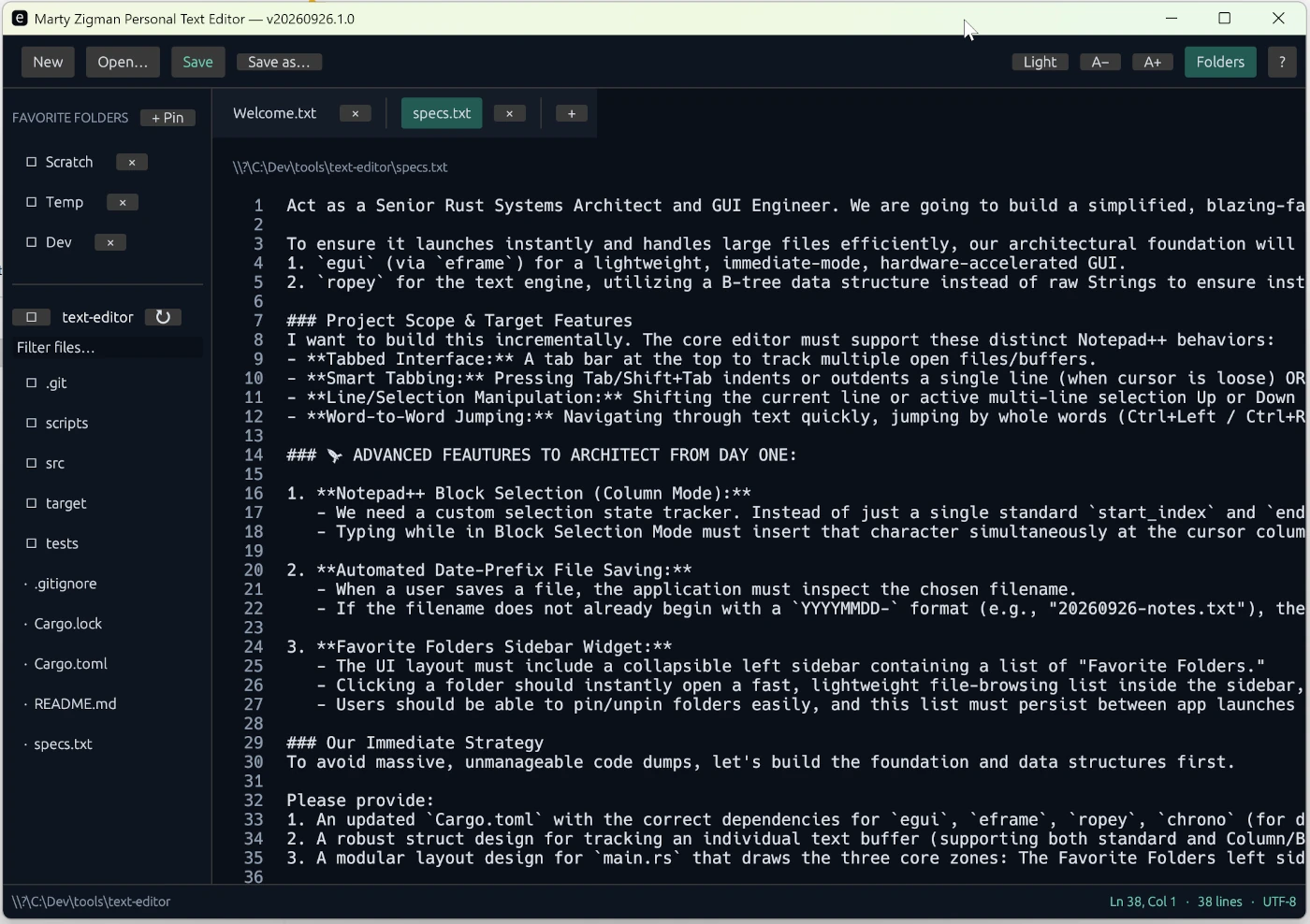
I am currently calling it the Marty Zigman Personal Text Editor. As I started using it, I noticed other things I wanted. I asked for those features. The application evolved. Indeed, I wrote the initial draft of this article using the editor. I do not present this screenshot because I believe the world needs another text editor. Nor does 30 minutes of development demonstrate that I have produced a mature, thoroughly tested commercial software product.
It demonstrates something much more interesting.
I no longer had to tolerate a persistent problem simply because the cost of starting was too high.
The minimum economic value a problem must have before it becomes worth solving with software has dropped dramatically.
The People Closest to the Problem Can Now Start Building
Consider what happens when we extend that observation beyond software developers.
A business leader notices that a process is failing. An operations manager knows what information is missing when a decision must be made. A controller understands why a report does not reconcile. A sales leader knows why people resist using the CRM system. These people have always possessed knowledge essential to producing good business software.
Historically, however, considerable distance existed between possessing that knowledge and producing an application. The business person might document requirements, meet with an analyst, compete for development resources, explain the concern to a developer, review a prototype weeks or months later, and then discover something important was lost in translation.
AI development tools are now so good that we can dramatically compress that distance. The business person can begin with the problem:
Here is what I am trying to accomplish. Here is where our current process breaks down. Help me think through what we need to build something better.
The person does not need to arrive with a complete technical specification. A productive AI conversation can expose missing questions, and I am impressed by how well it makes reasonable, assumption-based decisions. It’s only going to get better!
With appropriate care, that same conversation can begin producing working software while the understanding is still fresh. My colleague Chidi Okwudire recently documented a more consequential version of this phenomenon in his article, How AI Helps Systems-Minded Business Users Build a Better Experience on NetSuite.
The example matters because it shows both sides of the opportunity. A business leader with direct knowledge of field sales could use AI-assisted development to shape an experience around how salespeople actually work, while still benefiting from NetSuite’s underlying customer, contact, opportunity, activity, invoice, and revenue relationships.
Yet producing a working application was not the end of the story. As the solution moved toward production, questions of architecture, security, performance, testing, code management, and maintainability still demanded disciplined attention.
That distinction is critical.
The ability to create software is spreading. Responsibility for the result must spread with it.
Starting Is Becoming a Business Skill
This newly unleashed capacity has significant implications for NetSuite organizations. NetSuite gives us a governed foundation of transactions, accounting logic, permissions, business relationships, workflows, and operational information. But a strong information foundation doesn’t automatically mean everyone gets the best experience for their responsibilities.
In my article on providing the right NetSuite experience for the right actor, I argued that a planner, buyer, controller, warehouse worker, and executive may all depend on the same underlying business information but need very different ways to see and act on it.
AI-assisted development makes those purpose-built experiences increasingly practical.
Imagine a purchasing manager who knows buyers can’t easily determine which purchase orders deserve attention. The manager doesn’t need to start by requesting another dashboard. Instead, the manager can explain the business situation in a chat session for which they understand better than anyone else.
What decisions are buyers making? What signals indicate that intervention is needed? What exceptions matter? What information do buyers currently assemble manually? What action should become easier?
That understanding can increasingly be translated into a working experience quickly enough that people can react to something concrete instead of debating an abstract specification.
The first working version, however, begins another important process. Can this conversation be trusted? Is the information accurate? Are NetSuite permissions respected? Are accounting and operational relationships modeled correctly? Are exceptions handled? Does the new experience actually improve the business outcome?
AI can dramatically accelerate creation. It does not relieve us of the obligation to know whether what we created is right.
What Happens to the People Who Held the Scarce Skill?
There was another dimension of DHH’s keynote that I could and should not ignore.
He was speaking to an audience heavily populated by software developers. DHH was visibly enthusiastic about what had become possible. Yet reading reactions to the keynote revealed anxiety and disappointment among many people whose professional identity and economic livelihood have been built around software development.
One comment caught my attention (click on image):
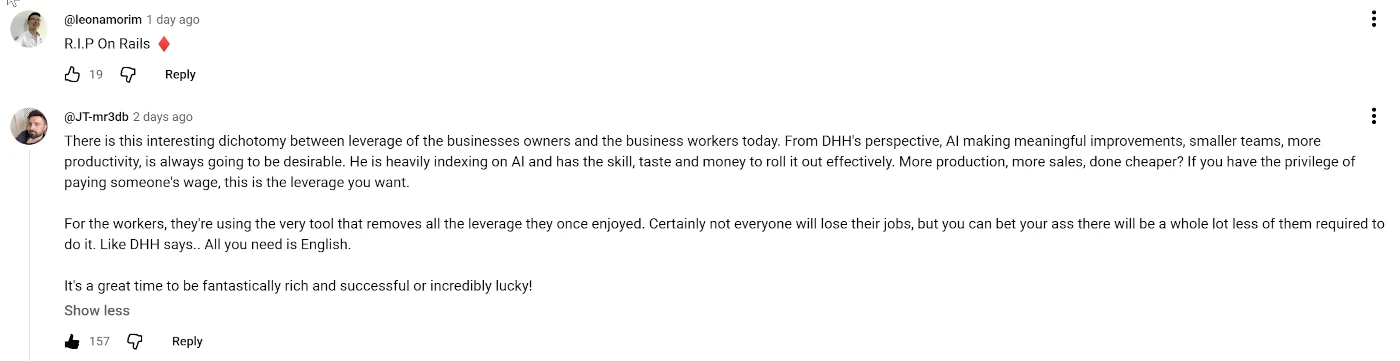
A viewer’s reaction to DHH’s Rails World 2026 keynote captures an important tension between greater organizational productivity and the changing economic value of traditional software development skills.
The commenter framed the issue as a tension between the leverage available to business owners and that available to workers. From an owner’s perspective, greater productivity is naturally attractive. I understand that perspective directly. As a business owner, I want our firm to produce better outcomes for clients with lower immediate and long-term costs. Our clients want the same thing from their investments.
But there is another perspective we should not casually dismiss. If someone’s economic leverage has historically come from possessing a scarce technical skill, what happens when AI makes portions of that skill dramatically more accessible? I do not think the useful response is to declare that expertise no longer matters.
Instead, I believe we need to ask where expertise is moving.
I believe the era in which software development belonged primarily to people who mastered the mechanics of writing code has ended. That does not mean disciplined software engineering disappears. It means typing the code increasingly becomes one component of a much larger value proposition.
Developing NetSuite Creators and Systems Thinkers
At Prolecto, we are actively working through this transition. We expect our people to grow their capabilities using AI tools. We want to become AI-augmented in the work we perform.
For our technically oriented professionals, knowing how to produce code cannot be the destination. We want them to develop a deeper understanding of business concerns and strengthen the capabilities traditionally associated with excellent systems analysts.
I discuss this often with our team in all of our roles. This is about leadership. I talked about this before the AI tools became so powerful. I see several skills becoming increasingly important:
- Understanding the Business Concern: What outcome are we actually trying to produce, and why does it matter?
- Listening and Discovery: What is the client really telling us? Is the requested report actually a reporting problem, or is there an unclear decision underneath it?
- Modeling: What entities, relationships, states, responsibilities, permissions, policies, and exceptions accurately describe the business situation?
- Judgment: Does the proposed solution actually make sense? Is the information trustworthy? What might the AI have misunderstood?
- Creation: Can we rapidly turn an understanding into something people can experience, test, criticize, and improve?
- Engineering Discipline: As the solution becomes consequential, can we ensure that it is secure, governed, performant, testable, maintainable, and appropriately integrated with NetSuite?
These capabilities are not exclusive to traditional developers. Our business-oriented professionals have an extraordinary opportunity to become makers themselves. Their knowledge of accounting, operations, inventory, supply chain, sales, service, and organizational commitments can increasingly be expressed directly through working software.
This changes what I think organizations should look for in their people. The emerging professional may be difficult to categorize simply as a “developer” or “business user.” I increasingly think of these people as creators and systems thinkers. They understand problems deeply, model them carefully, use powerful tools aggressively, and know when a rapidly generated result requires greater scrutiny.
Raising the Standard for NetSuite Problem Solving
My text editor was a modest experiment. Yet it changed something important in my assumptions. For decades, I quietly accepted a particular problem because solving it wasn’t worth the investment. In about 30 minutes, that calculation changed.
Now multiply that phenomenon across millions of people. Consider the operations manager who has tolerated an awkward process for years. The controller who knows exactly why a reconciliation is unnecessarily difficult. The sales leader who understands why representatives avoid the CRM system. The NetSuite administrator who can see a better way for people to work but previously lacked the development resources to bring that idea into existence.
These people can start creating today. That does not eliminate the need for expertise. It raises the standard for what we should call expertise.
At Prolecto, this is the kind of professional we want to cultivate and the kind of work that excites us. We bring our intellectual property, algorithms, patterns, and solutions to our clients without additional license charges because our objective is not to manufacture scarcity around software. We want to apply our expertise, listening skills, modeling capabilities, and execution discipline to help capable organizations produce better business outcomes.
For the NetSuite community, the question increasingly is not simply, “Who can develop this?” A more interesting question is, “Who understands this problem well enough to create something better?”
If you found this article relevant, feel free to sign up for notifications to new articles as I post them. If you are ready to rethink how AI-augmented creators can help you get more from your NetSuite investment, let’s have a conversation.