


This article is relevant to NetSuite customers and practitioners contemplating how artificial intelligence is changing the nature of human work. While much of the attention around AI focuses on automation, I believe we have an opportunity to fundamentally rethink the NetSuite application experience for business professionals whose work requires thoughtful consideration and sound judgment.
Background
For much of my career working with business systems, we have sought to make organizations more productive by automating business processes and providing better access to information. Accordingly, we (collectively) have made considerable investment in transactional systems, reporting capabilities and business intelligence tools.
With the emergence of artificial intelligence, I believe it is worth revisiting some of our fundamental assumptions about how we conceive business applications. In particular, I am interested in how the changing division of labor between people and computers should influence the application experiences we cultivate.
The Changing Nature of the Business Systems User
I believe we can reasonably anticipate a time when virtually all mundane data entry activities will be candidates for automation, whether through AI agents or conventional software automation. The implications for business application design are significant.
Consider the emerging importance of the analyst and the planner. These individuals are distinguished by their ability to understand business conditions, weigh competing objectives and exercise judgment. Their work is more deliberate and sophisticated. Over time, I suspect these individuals will increasingly direct AI agents much as managers have historically directed administrative staff. These are the jobs of the future.
What kind of application experience should we be conceiving for these professionals?
Are We Trying to Understand Our Business or Make It Operate Better?
When NetSuite customers express interest in business intelligence (BI) tools, I find it valuable to distinguish between two objectives:
- Understanding the business: Help me comprehend what is happening in my business.
- Operating the business better: Help me determine what to do and put my decisions into effect.
The business intelligence industry has developed considerable sophistication around the first objective. Yet with emerging AI capabilities and direct access to NetSuite information, I suspect many organizations can satisfy their analytical inquiries without adding another layer of technology infrastructure.
The second objective presents a different opportunity. Consider an inventory planner who discovers an approaching stock shortage. Understanding the shortage is useful. Yet the planner must still consider supplier lead times, purchasing quantities, customer commitments, and the working capital needed to resolve the situation.
What if we brought these analytical capacities directly into the application where the planner makes and executes purchasing decisions?
Rethinking Traditional NetSuite User Interfaces
Historically, NetSuite has presented information through three primary application patterns:
| Application Pattern | Traditional Purpose |
|---|---|
| Record Keeping | Search, list and maintain business records. |
| Dashboards and Portlets | Monitor business conditions and key indicators. |
| SuiteAnalytics Workbooks and Saved Searches | Investigate, analyze and report on business information. |
These are meaningful application capabilities. As I discussed in my article, SuiteWorld 2026: NetSuite Next Is Now. What Should We Make of It?, Oracle is advancing the NetSuite experience through AI and other innovations. Yet I believe an important opportunity remains to rethink how we bring information and transactional capabilities together for the sophisticated business user.
Introducing the Subject Domain Workbench
In user experience (UX) design circles, concepts such as visual analytics, embedded analytics, direct manipulation and decision-centric design help describe the application pattern I have in mind.
I suggest we bring these concepts together under the notion of a Subject Domain Workbench.
A Subject Domain Workbench is an interactive analytical application organized around a specific business discipline that unifies data visualization, parameter manipulation, computational modeling and transactional execution.
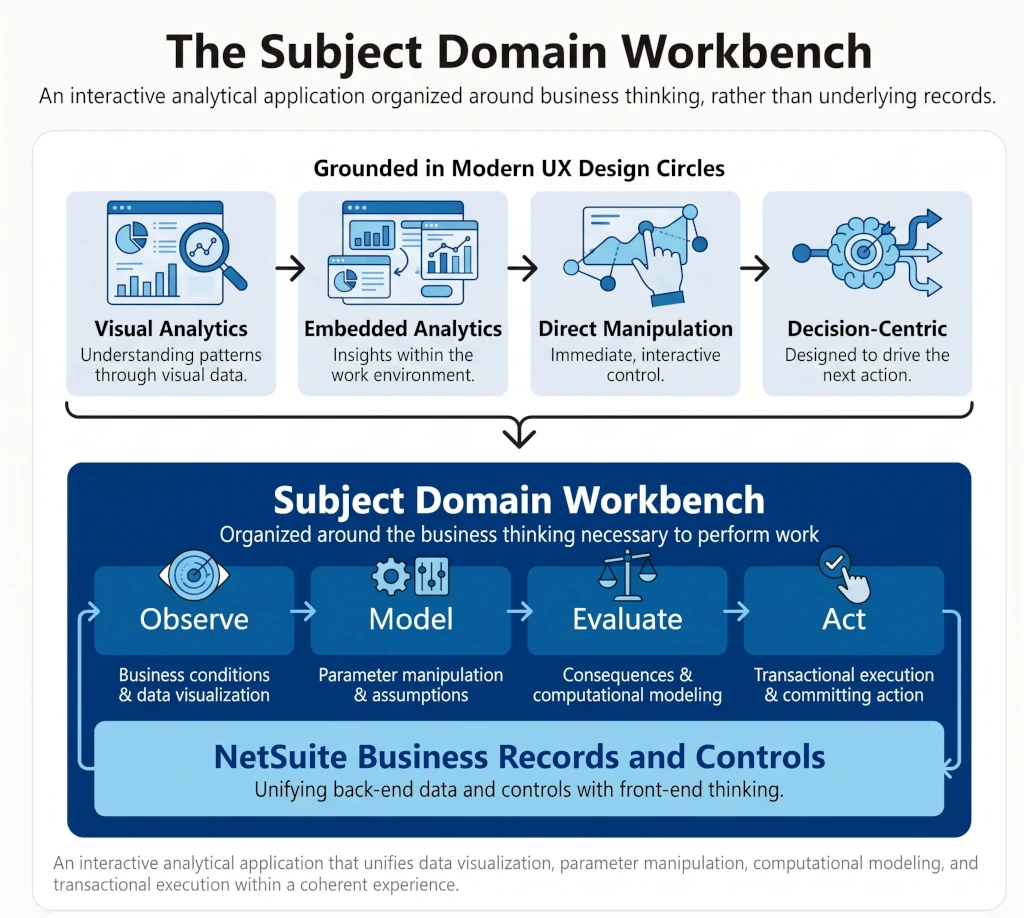 The distinction is important. Rather than organizing the application around the underlying NetSuite records, we organize the experience around the business thinking necessary to perform the work. The analyst can observe business conditions, manipulate assumptions, evaluate consequences and commit to a course of action, all within a coherent application experience.
Consider the following three examples.
1. Inventory Planning: Balance Product Availability and Working Capital
An inventory planner must balance the desire to satisfy customer demand against the investment required to carry inventory.
Imagine a NetSuite workbench that presents projected inventory balances alongside editable purchasing quantities, supplier lead times and safety stock parameters. As the planner modifies these values, the graphical representation of future inventory conditions immediately responds. The planner can see the consequences of a purchasing decision, including potential shortages and the capital required to avoid them. Once satisfied, the planner can generate purchase orders or revise NetSuite replenishment parameters.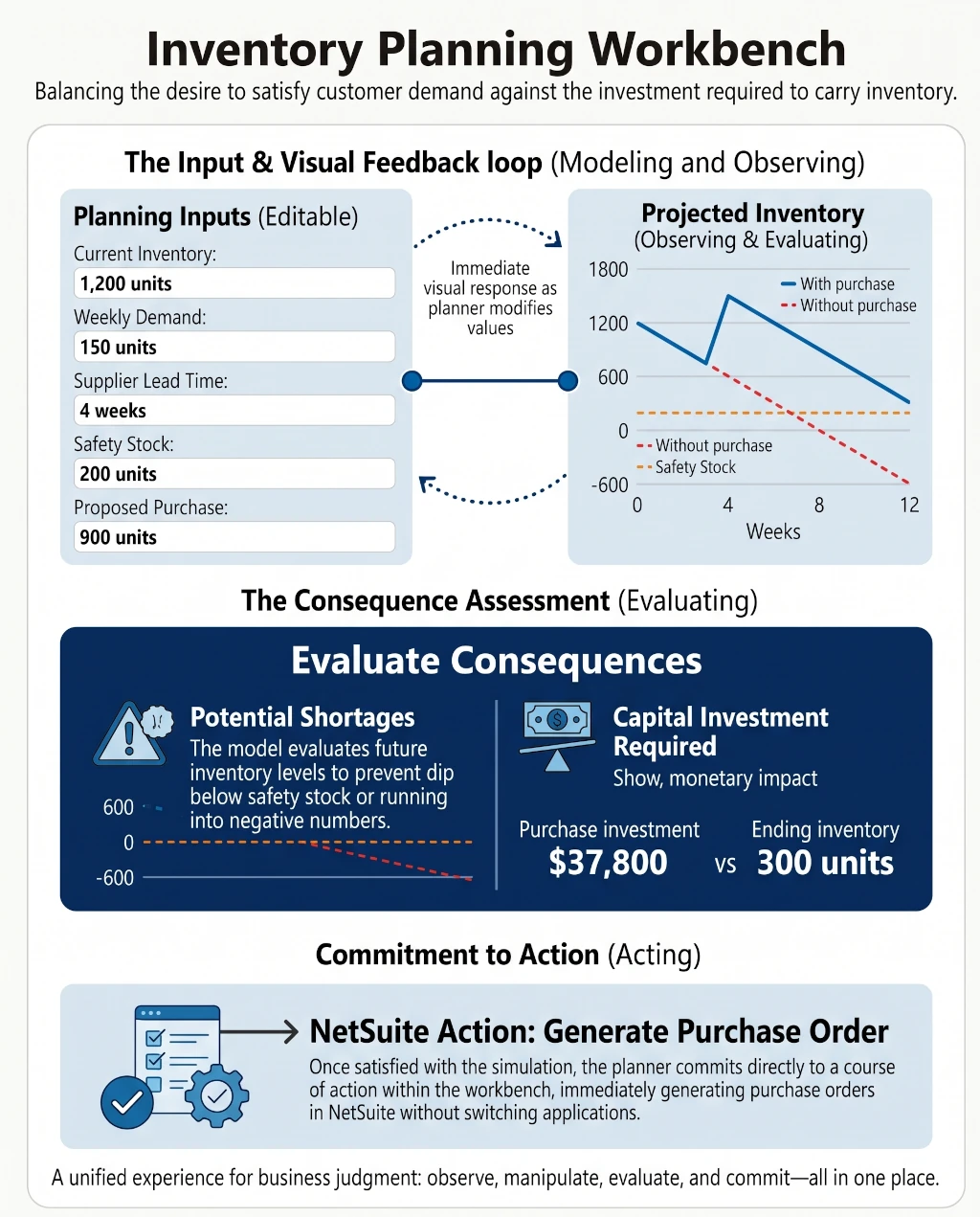
The graph is no longer simply a report. It becomes a tool for business judgment. Click the image to see full screen for inspiration.
2. Manufacturing Planning: Reconcile Demand and Production Capacity
A manufacturing planner must reconcile customer commitments with material availability, machine capacity, labor and production economics.
Imagine a workbench that lets the planner adjust production quantities while simultaneously observing work center utilization, material requirements and projected contribution margins. A production bottleneck becomes immediately apparent. The planner can consider alternative production mixes, overtime or changes to the production schedule and evaluate the consequences before committing to work orders.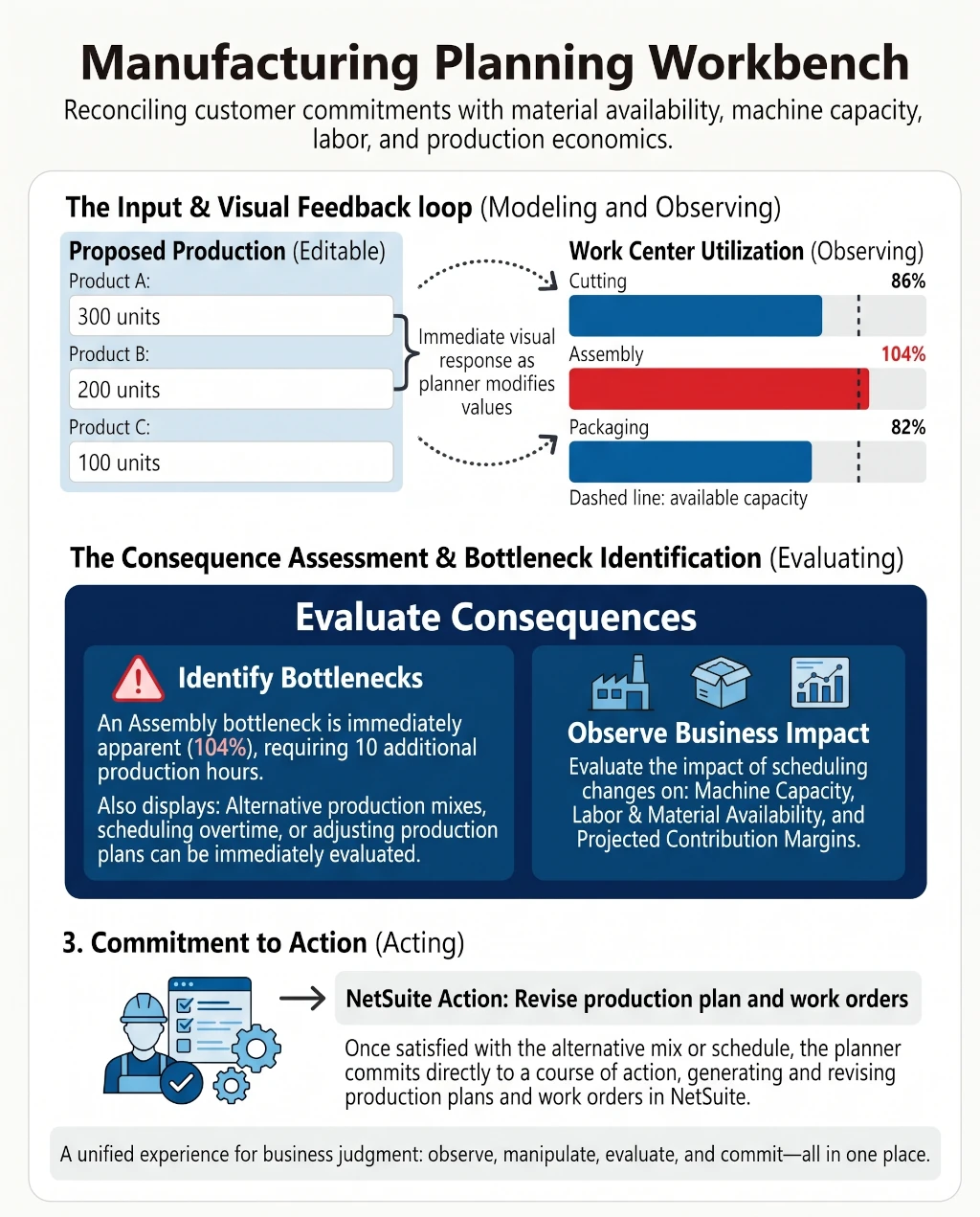
Rather than discovering operational problems after transactions have been generated, we help the planner anticipate and resolve them. Click the image to see larger.
3. Professional Services Planning: Effectively Deploy Professional Talent
In professional services organizations, a resource allocation record captures an assignment. Yet making a good assignment takes much more thought than maintaining the record.
Imagine a workbench that brings together client commitments, professional competencies, resource availability, utilization and projected profitability. A services manager considering accelerating a client project can explore alternative resource assignments and immediately see the implications for other projects, staff capacity and financial performance. Once a satisfactory plan emerges, the manager can revise NetSuite resource allocations and project schedules.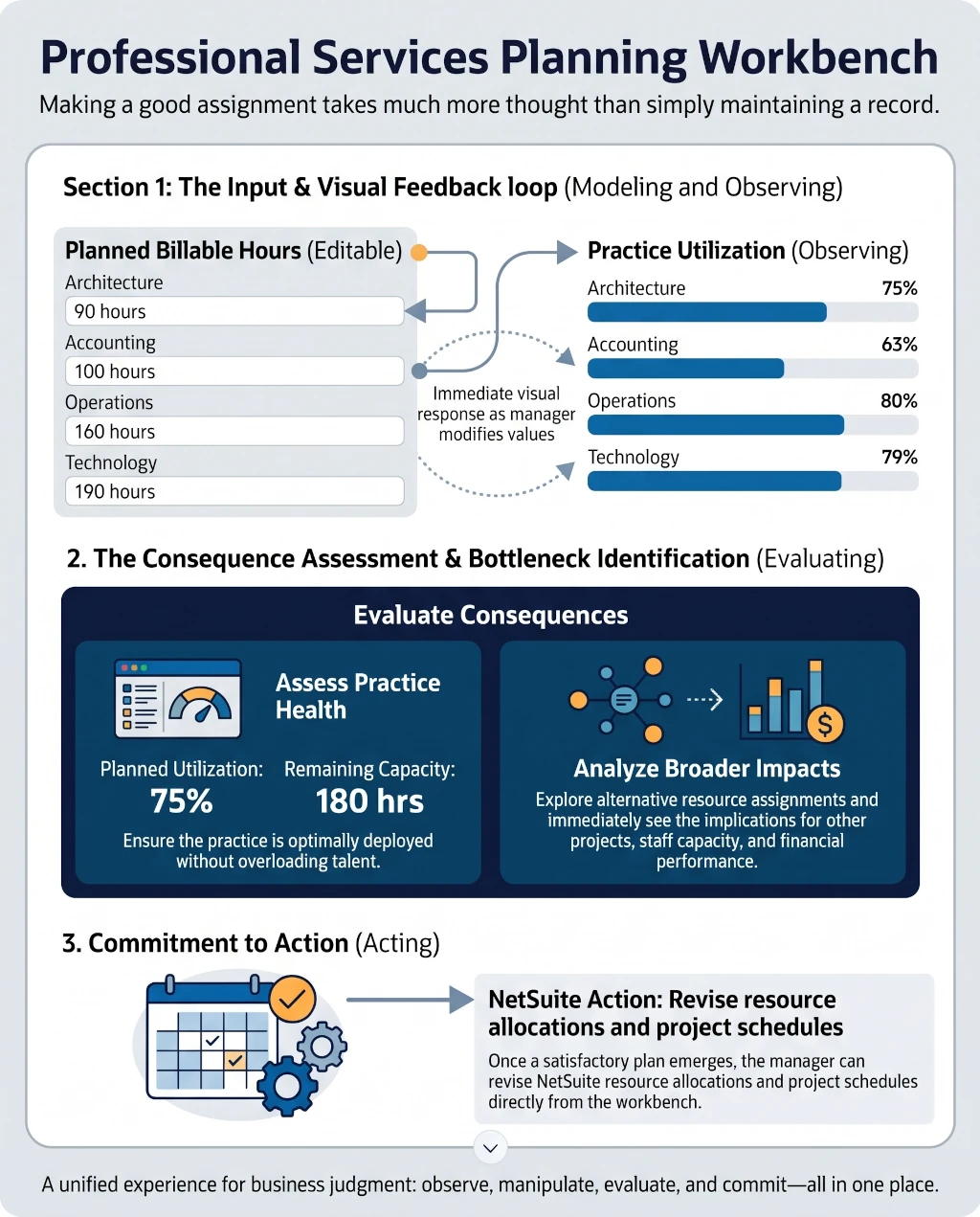
In each of these three examples, we are helping business professionals manage scarce resources against competing objectives. We are making the business operate better.
Our History of Innovating the NetSuite User Experience
At Prolecto Resources, we have long recognized the opportunity to use the NetSuite platform to deliver application experiences that extend beyond conventional record forms and reports.
Before today’s frontier AI models emerged, we were already investing in these capabilities with our clients. Consider some of our published work:
- 2018: Simplifying NetSuite Transaction Entry Interfaces
- 2020: Learn to Code a Simple NetSuite Suitelet with MVC Pattern
- 2022: NetSuite Customer Facing HTML-Based Order Viewer Demonstration
- 2022: Unleash NetSuite’s User Interface by Innovating via the Platform
- 2023: Revamping NetSuite Cases: A High-Performance, Exceptionally User-Friendly Experience
- 2024: Deliver Complex NetSuite Outputs via User-Centric Options
Historically, because of the effort and risk, we had to weigh the value of these application experiences against the considerable effort required to produce them. However, consider my article, Rethinking Make vs. Buy for High Performance NetSuite Applications in the AI Era. It’s real and within reach. Once our clients understand, they embrace the potential.
Frontier AI Models Are Unleashing Our Application Creativity
With the emergence of sophisticated AI-assisted development tools, such as Anthropic’s Claude Code, we can explore application possibilities that were previously difficult to justify economically.
Consider the progression of our more recently published work:
- May 2026: NetSuite, AI, and the Discipline of Building Serious Business Systems
- June 2026: The Next Frontier in NetSuite Manufacturing: AI-Augmented Planning and Control
- June 2026: How AI-Augmented Interfaces Make NetSuite Change Orders Clearer, Faster, and More Governed
- July 2026: The Right NetSuite Experience for the Right Actor at the Right Time
- September 2026: How AI Helps Systems-Minded Business Users Build a Better Experience on NetSuite
What excites me is not simply that we can construct applications faster. We are increasingly free to contemplate more creative and sophisticated ways to solve business challenges. Furthermore, the resulting applications do not necessarily need artificial intelligence to operate. We can use AI to help with conception and construction while relying on conventional, deterministic business logic to produce trustworthy, reproducible results.
With NetSuite’s SuiteQL, SuiteScript and Suitelet capacities, we already have much of the infrastructure necessary to deliver these experiences directly on the platform.
The Emerging Importance of the NetSuite Systems Analyst
These developments reinforce our thinking at Prolecto about the importance of cultivating the NetSuite Systems Analyst. See my recent article, ERP as We Know It Is Ending. Who Must We Become?. Creating an attractive application interface is becoming increasingly accessible. Yet understanding what the application ought to do remains a sophisticated intellectual endeavor. We need professionals who can listen carefully, comprehend the business challenge, model information relationships and conceive meaningful application experiences.
AI-assisted prototyping allows us to move more fluidly between these activities. We can present emerging application concepts to business professionals, listen to their assessments, discover previously unarticulated requirements and iteratively refine our thinking. This represents more than a breakthrough in software construction. It offers us a potentially better way to listen to and understand our clients.
Unlock More of the Power of Your NetSuite Investment
Before investing in additional business intelligence infrastructure, I encourage NetSuite customers to consider the nature of the business challenge they are trying to solve. We had one client who was convinced he needed Microsoft Power BI. But after we worked with him to understand this kind of thinking and showed examples of work for other clients, he decided this approach was the way to go. He preserved capital to focus on helping the business operate better.
There are certainly circumstances where dedicated BI tools and data warehouses are appropriate. Yet if the objective is to help an inventory planner, manufacturing planner, or services manager become more effective in their work, perhaps we should be conceiving a better NetSuite application experience. As routine business activity becomes increasingly automated, we should relentlessly pursue ways to make our more thoughtful business professionals productive. We have an opportunity to help them become better informed, make fewer errors, exercise better judgment and act with greater confidence.
If you found this article relevant, sign up for notifications as I publish new articles. If you are interested in exploring how these application design patterns can help your organization unlock more of the power of NetSuite, let’s have a conversation.