


This article is relevant if you are a NetSuite customer or professional seeking to understand what NetSuite Next, Ask Oracle, and emerging AI capabilities mean for your organization.
TL;DR Summary
SuiteWorld 2026 (watch On Air) confirmed that NetSuite Next is moving from promise to practical reality. Oracle is embedding conversational AI into ERP, supported by OpenAI’s GPT family and other models. The opportunities are meaningful, but realizing them still demands professional competency, business modeling, and sound execution controls.
Background: Observations from SuiteWorld 2026
Our Prolecto Resources team attended SuiteWorld 2026 primarily to connect with existing and prospective clients and partners. Running alongside SuiteWorld was Oracle AI World. I walked over with my colleague David Mish to gain perspective on Oracle’s larger enterprise offerings. The contrast reinforced why I appreciate serving the middle market. Oracle is a powerhouse in enterprise systems, yet our firm can make meaningful business improvements within more reasonable timeframes.
This year’s SuiteWorld was overwhelmingly about NetSuite Next and AI. Having previously explored Next in demo environments, I questioned its readiness because of performance and other limitations. My recent experience suggests those concerns have substantially diminished. My assessment: NetSuite Next is here, and we need to become competent with it.
Understanding the NetSuite Next Experience
The redesigned interface introduces bottom-oriented navigation, prominent global search, and expandable menus for familiar functions. Forms, lists, and filtering mechanisms have changed, but much of the underlying application remains recognizable. Experienced users will need time to recover their productivity. New users, however, can learn the new experience without the habits developed around the traditional interface. For consultants, this is no longer merely something to watch.
Ask Oracle: Bringing Chat into the Application
The central attraction is Ask Oracle, which allows users to interact with their ERP conversationally. I call this Chat in the App, as I see many vendors working to enable this mechanism in their applications.
From conversations at SuiteWorld, I encountered two broad interpretations.
- Enthusiastic Readiness: Customers see opportunities for better adoption, satisfaction, and access to business information. Their enthusiasm assumes the system understands context, respects permissions, and produces trustworthy results.
- Doubtful Readiness: Customers already working with frontier models such as Claude and ChatGPT evaluate Ask Oracle against demanding high standards for reasoning and application building.
I belong to the second group, although I appreciate the first. Our firm routinely connects external AI tools to NetSuite and engineers mechanisms for persisting useful outcomes. Oracle’s embedded approach reduces these burdens for ordinary users.
OpenAI Models Behind Ask Oracle: An Important Discovery
Working with Ask Oracle, I was pleased with its outputs and its responsiveness. Looking into the architecture helped me understand why.
Oracle’s SuiteAnswers article 78796, Standard NetSuite Next Generative AI Features and AI Models, confirms that Ask Oracle uses OpenAI GPT-OSS and GPT-4.x or GPT-5.x models, depending on the task.
This was a pleasant surprise.
Other capabilities use different models. Intelligent Close Manager’s task prioritization and Narrative Insights use GPT-4.x, while Case Summary, Enriched Bank Data, and Item Creation Assistant use Cohere Command A. Prompt Studio supports both OpenAI and Cohere models. Click image to see table fullscreen. 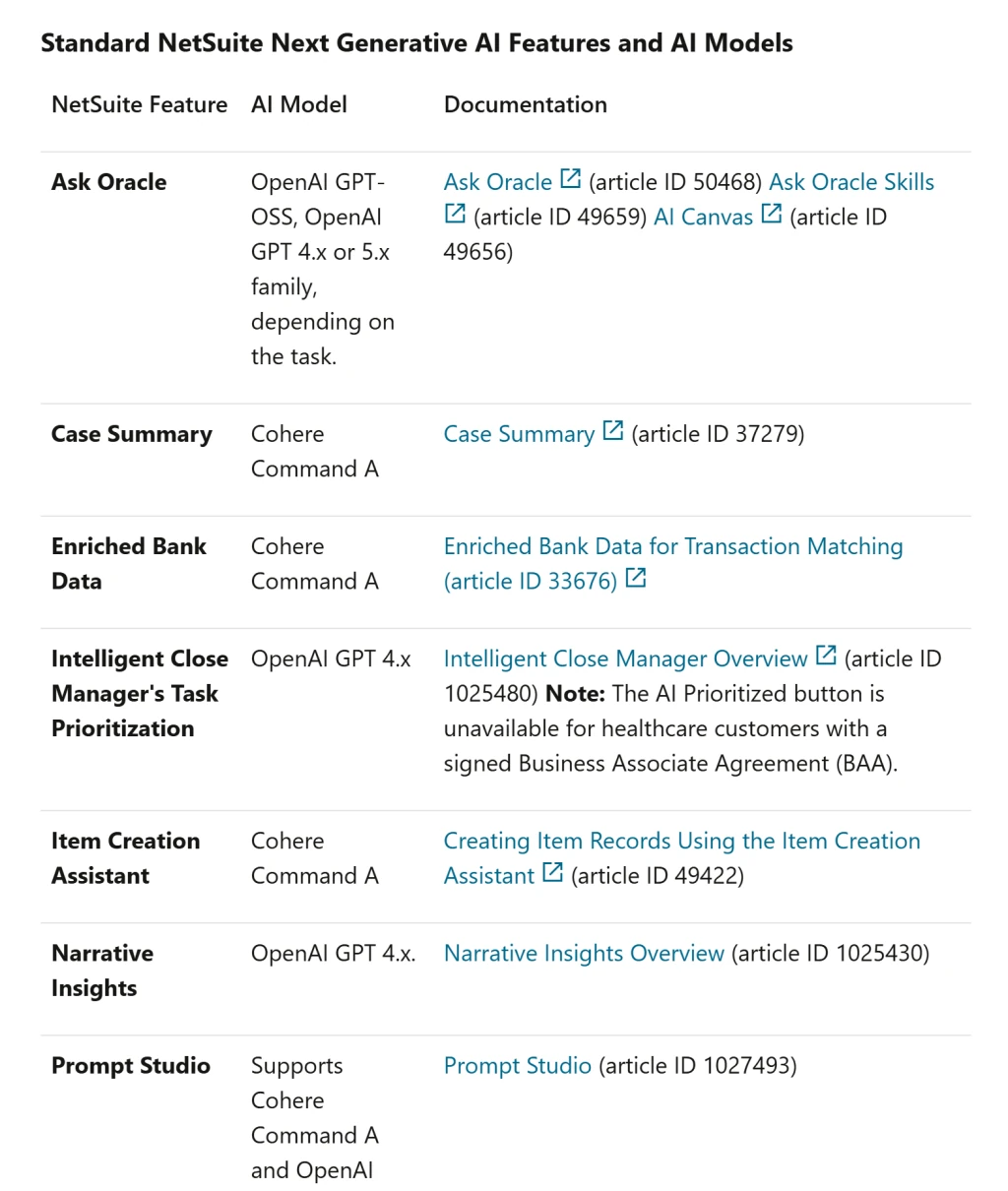
Having worked extensively with OpenAI and Anthropic’s frontier models, I have developed expectations for what these systems can accomplish, particularly in reasoning and software construction. Learning that Ask Oracle incorporates OpenAI models helps explain why the experience exceeded my earlier expectations. More importantly, Oracle is demonstrating an architecture that can employ different models for different business purposes. I interpret this as an important strategic advantage. As models improve, Oracle can strengthen its AI capabilities without requiring customers to rebuild their ERP systems.
The October 27, 2026 Oracle and OpenAI collaboration announcement reinforces this direction. Oracle is bringing OpenAI models, ChatGPT, and Codex closer to its enterprise applications and infrastructure. Of course, a powerful model does not automatically produce a powerful application. Business context, available tools, permissions, and architecture govern what it can accomplish. Nevertheless, I am encouraged.
We should think of Ask Oracle as an opening generation of capabilities, not their ultimate limit.
Practical NetSuite AI Capabilities Worth Exploring
Several capabilities caught my attention.
Skills Library: Providing Business Context
Ask Oracle offers skills that guide recurring work patterns. Oracle-provided skills can serve as starting points, while custom skills can encode business-specific knowledge. I see skills as mechanisms for helping AI understand our data, terminology, and expectations. They can improve consistency, although they cannot independently guarantee correctness.
AI Portlets: Reporting Through Conversation
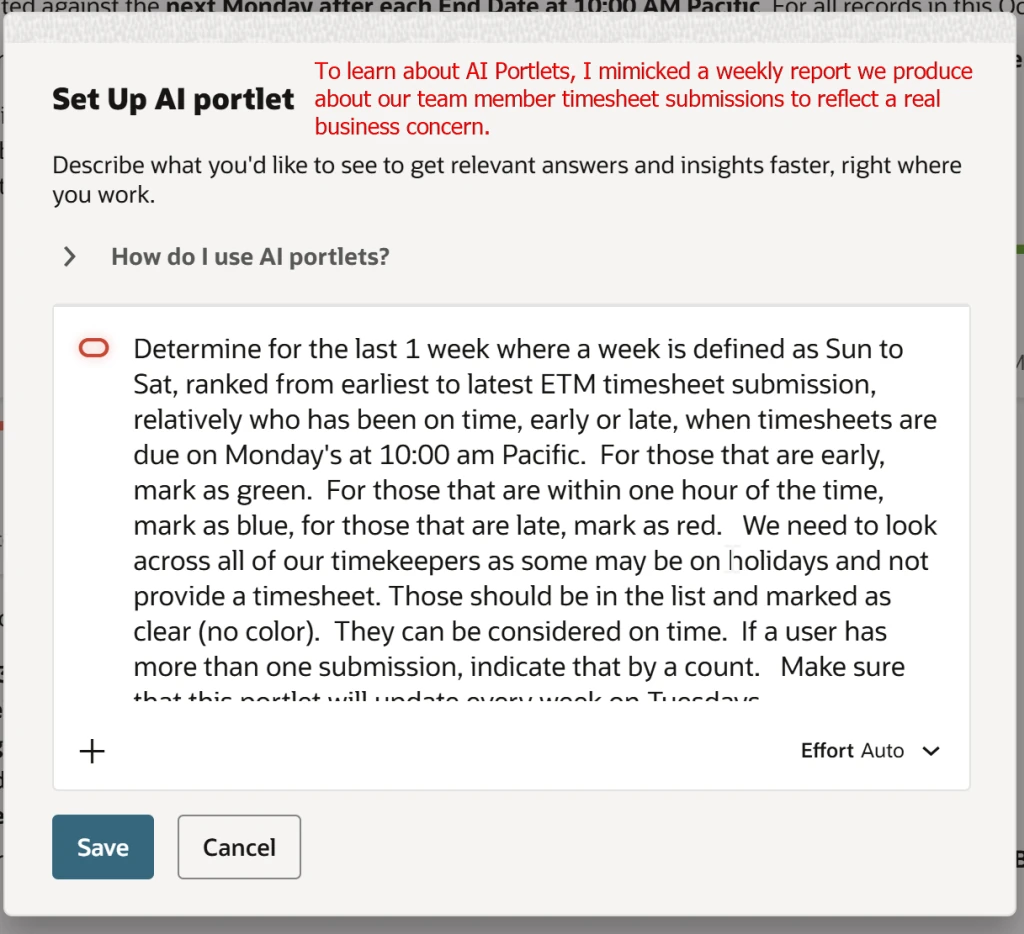
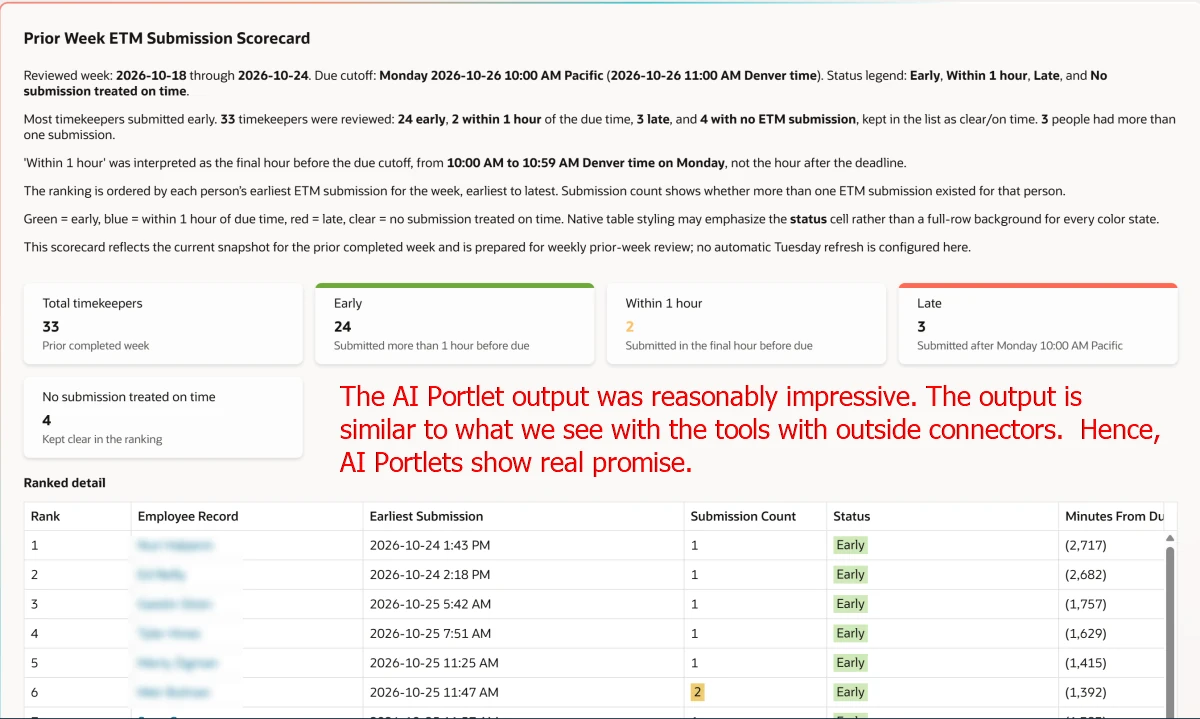
I challenged AI Portlets to produce a weekly ranking of our consultants based on timely timesheet submissions. Within minutes, I had a useful result, including narratives, summaries, and supporting details. I refined it conversationally. I was impressed. This represents an advance beyond traditional dashboard portlets. I still want to evaluate sharing, refresh behavior, and fine-tuning. Click the images to see full screen.
AI Canvas: A Richer Analytical Workspace
AI Canvas provides a more elaborate analytical workspace. I think of it as moving toward experiences traditionally engineered through Suitelets, although its capabilities are not equivalent. I want to better understand its lifecycle, permissions, and distribution before forming stronger conclusions.
Agent Studio: From Asking to Acting
Here is where my curiosity becomes strongest. Customers want agents that can responsibly perform business work. When I experimented with a custom agent, I ran into the need for technical tooling and clearly defined execution roles. I naturally wanted the agent to construct more of its own foundation. Instead, it directed me toward conventional development work. My interpretation is that powerful agent workflows still require technically capable professionals to engineer their underlying tools and controls. I expect this boundary to move.
The NetSuite AI Connector Service: Another Important Path
NetSuite’s AI Connector Service uses Model Context Protocol (MCP) to connect compatible external AI clients, including Claude and ChatGPT. We encourage clients to begin exploring these capabilities through restricted, read-only roles. In development, we may enable write capabilities in sandboxes for configuration and testing. We exercise considerably greater caution in production.
We also distinguish AI reasoning from deterministic business logic. An agent may help design a solution, while a conventional Suitelet or scripted process may be better for repetitive transactions. The objective is dependable business outcomes, not maximum AI consumption.
AI Units and the Economics of Consumption
Oracle has introduced AI Units and monitoring capabilities to measure AI consumption. As adoption grows, organizations will need to understand the value and cost of increasingly sophisticated workflows. This reinforces the need to distinguish problems deserving substantial reasoning from those better addressed through deterministic automation.
SuiteExpress: Rethinking ERP Implementation
Another significant announcement was SuiteExpress, Oracle’s AI-assisted implementation approach. I welcome the direction, especially if it departs from SuiteSuccess. This is a pattern and not a software application at this point.
At Prolecto, we are exploring how three knowledge sources support implementation leadership:
- NetSuite Knowledge: Platform capabilities and constraints. We find Help and SuiteAnswers to be a great repository.
- Prolecto Knowledge: Architecture, intellectual property, and implementation experience. This lives centrally in our document stores today.
- Client Knowledge: Business understanding developed through listening, workshop recordings, Roadmap planning, and design prototypes.
Oracle emphasizes faster implementation. I place greater importance on thoroughness, business fit, and trustworthy outcomes. As discussed in my 2025 article, Modeling: The Leadership Discipline Behind NetSuite Excellence, configuration follows from understanding the business model. AI may make disciplined modeling more valuable than ever.
Developing Competence for the Next NetSuite Era
I left SuiteWorld encouraged. NetSuite Next represents meaningful progress. Oracle’s ability to incorporate advanced AI models, including those from OpenAI, creates opportunities for continued improvement.
At Prolecto Resources, our obligation remains unchanged: listen carefully, model the business, engineer dependable solutions, and help clients realize their NetSuite investment. We welcome tools that make this work more productive. We also recognize that trust is earned through outcomes, not demonstrations.
Evan Goldberg’s October 27 article, The End of ERP as We Know It, presents a larger vision. I intend to explore those implications separately, especially what they mean for the business systems professional.
If you found this article relevant, sign up for notifications as I publish new insights. If you are evaluating NetSuite Next or planning your AI strategy, let’s have a conversation.