


This article is relevant if you are a business executive or NetSuite professional considering how artificial intelligence will change your organization and what it will demand of the people responsible for making the business work.
TL;DR Summary
As AI increasingly understands our business systems and performs work on our behalf, the greater challenge may be human, not technical. We must become better at understanding what matters, modeling how commitments are fulfilled, and accepting responsibility for trustworthy outcomes. A simple inventory allocation decision helps explain why.
Background: The Promise of NetSuite Next
I left SuiteWorld 2026 encouraged by Oracle NetSuite’s commitment to artificial intelligence. In my recent practical assessment, I explored NetSuite Next, Ask Oracle, and emerging agentic capabilities. I concluded that these technologies now embedded in NetSuite are becoming meaningful and that we need to develop competency with them.
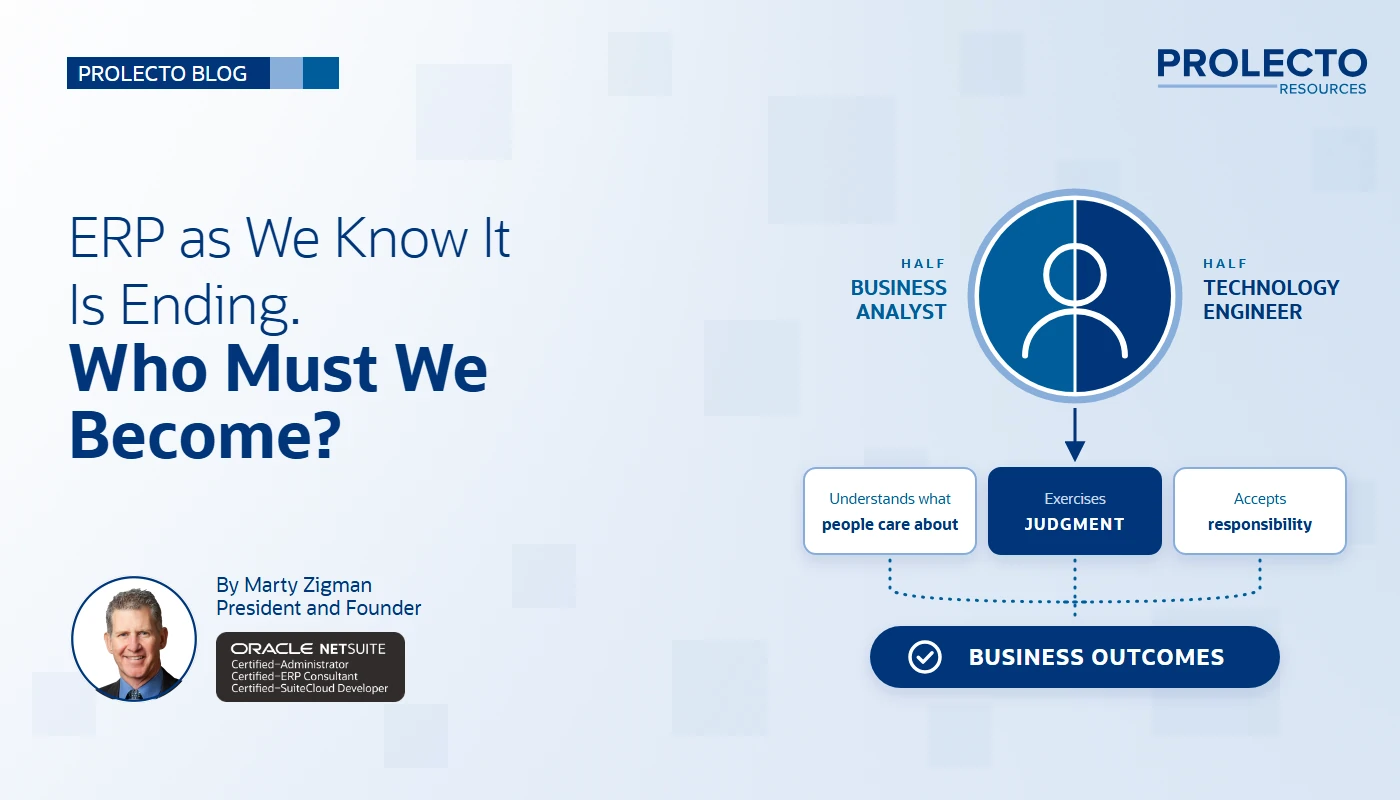
NetSuite founder Evan Goldberg goes further in his article, The End of ERP as We Know It. He argues that ERP should come to us, fit our business, and increasingly work on our behalf. I appreciate this vision. Yet it raises a deeper question: As our systems become more capable, who must we become to remain valuable professionals? This question is on the mind of many in my circle.
When NetSuite Knows the Inventory but Not What Matters
Consider a distributor with 100 units available and two customers requesting 80 units each. One customer placed the order first. Another is a strategic customer with a contractual service commitment. The first order has a higher margin, while the second relationship may matter for long-term growth. Which customer gets the inventory?
NetSuite can identify the orders, quantities, margins, fulfillment history, and customer relationships. An intelligent agent might evaluate alternatives and recommend an allocation. But what constitutes the right decision? The answer depends on what the business cares about.
Should we honor the earliest commitment? Protect margin? Favor contractual obligations? Preserve a strategic relationship? Could we split inventory, expedite replenishment, or negotiate revised delivery dates? These are competing business values. There is no universally correct mixture.
Executives establish what matters. Good managers understand those priorities, make commitments, and exercise judgment within their authority. People make commitments and bear the consequences. Technology may increasingly perform the work, but it does not assume that human responsibility.
What Our Historical Decisions Reveal
Here is where AI becomes interesting. Our business systems contain years of evidence about how we have actually operated. Which customers received priority? When did we override credit holds? Which margin exceptions were approved? An agent could study our systems and help reveal the preferences embedded in those decisions. But an essential distinction remains: What we have practiced is not necessarily what we ought to practice.
Historical decisions may reflect thoughtful judgment, but they may also expose outdated assumptions or inconsistent behavior. Imagine executives discovering that their stated commitment to customer fairness differs substantially from actual allocation practices. That insight offers more than automation. It offers an opportunity for operational excellence by helping an organization become conscious of the policies it has been practicing. Divergence between intent vs. practice becomes the operating consideration.
Translating Executive Intentions into Gates & Guardrails
At Prolecto, we have long worked on mechanisms we call Gates & Guardrails, including our NetSuite Record State Manager.
The larger purpose is to help organizations translate managerial intentions into operating controls. A gate specifies conditions that must be satisfied before an action proceeds. A guardrail establishes boundaries within which responsible actors can exercise discretion. While NetSuite is beginning to speak about guardrails in the Next-enabled platform, it misses this entire domain of intention and rule definition.
Returning to inventory allocation, management might establish minimum service commitments, customer priorities, margin tolerances, and escalation requirements. Within these boundaries, a manager, or a properly authorized agent, can evaluate alternatives and act. When values conflict, or material consequences exceed delegated authority, the decision returns to a responsible person. Our pattern for managing intent from practice gets closer to true exception-based processing.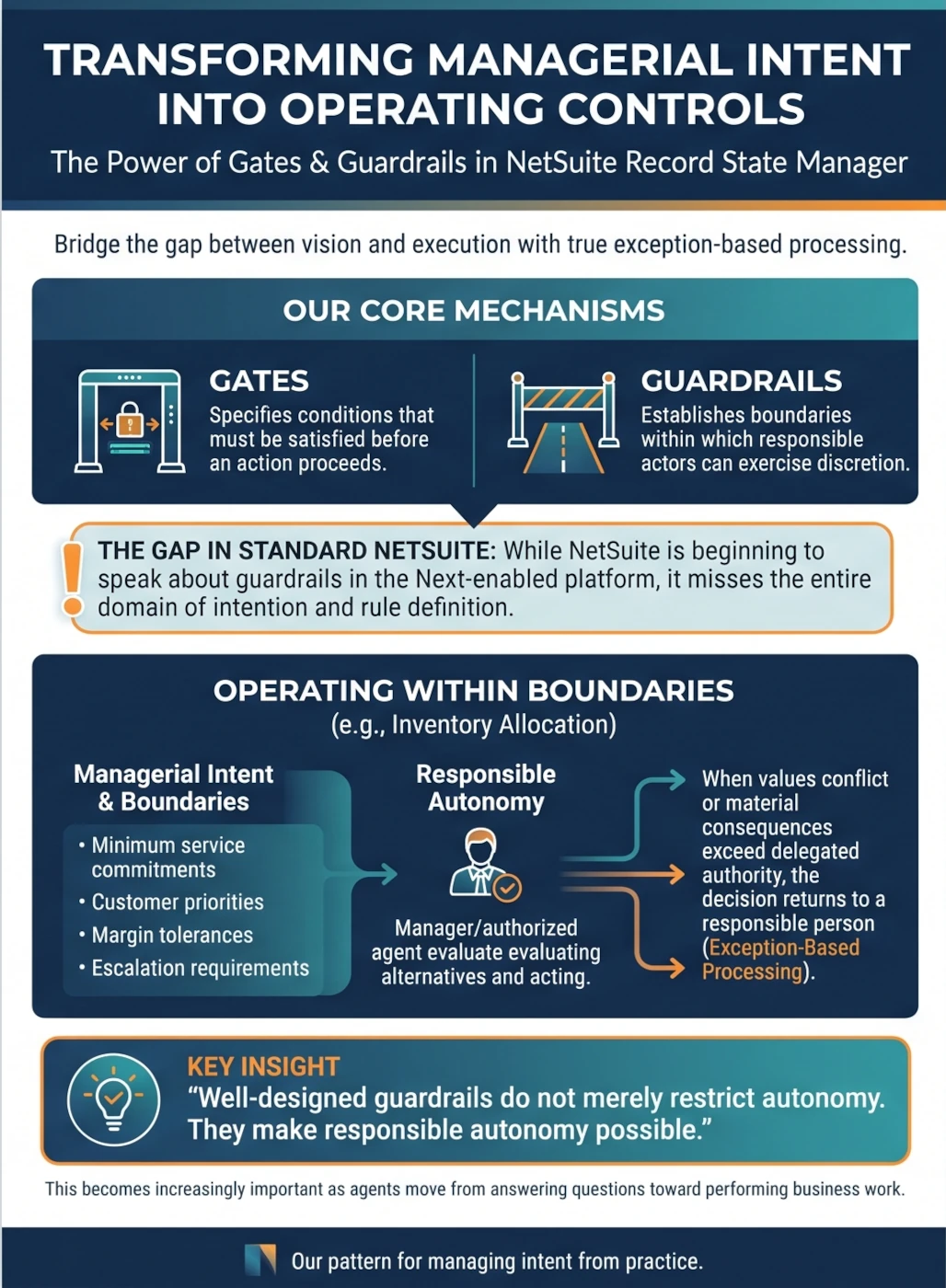
Here is the insight: well-designed guardrails do not merely restrict autonomy. They make responsible autonomy possible. This distinction becomes increasingly important as agents move from answering questions toward performing business work.
Business, Model, Fit: Why the Sequence Matters
Our Prolecto Roadmap methodology follows a longstanding principle: People, Process, Technology.
- People come first because they care about outcomes, make commitments, and experience consequences.
- Process expresses how people intend to coordinate information, relationships, decisions, and controls to fulfill those commitments.
- Technology is fitted to that model.
We express this through Business, Model, Fit. Before asking how NetSuite should allocate inventory, we want to understand the organization’s service promises, operating priorities, and decision-making responsibilities. We then model the desired practice before fitting NetSuite and supporting technologies to it. AI makes this discipline more important. When software becomes easier to produce, we can build poorly conceived solutions faster than ever. The constraint increasingly becomes the quality of our business understanding.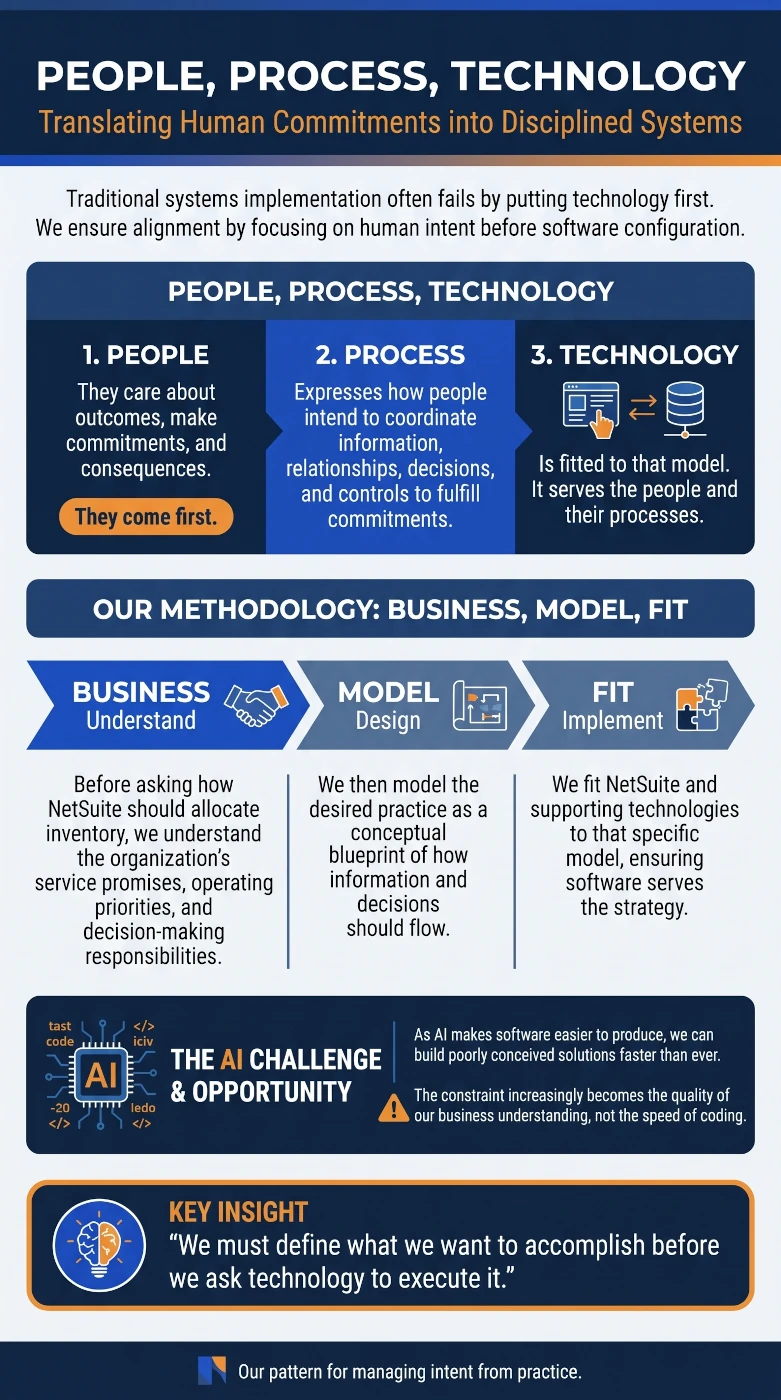
The Professional We Must Become
What will executives value as technology becomes capable of performing more work? I believe they will seek professionals who understand business economics, listen carefully, recognize competing commitments, model operating relationships, and exercise sound judgment.
In contemplating the types of education required, this is not simply a matter of hiring MBAs or computer scientists. Neither credential alone is sufficient. At Prolecto, I see our Business Analysts becoming increasingly empowered to create working solutions through AI-assisted technologies. Their challenge is to strengthen their technical judgment and responsibility for what they produce. Our Technology Engineers bring tremendous systems knowledge, but some traditional programming work is becoming easier. Their opportunity is to move closer to business purpose, operating design, and direct ownership of outcomes.
The analyst must become better at producing solutions. The engineer must become better at understanding the business. Both are moving toward a more complete Business Systems Architect: someone who can listen, conceive, model, build, and validate a trustworthy business capability.
Building Systems Worthy of Trust
I share Evan Goldberg’s excitement. Enterprise software is becoming more accessible, adaptable, and capable. Yet returning to our inventory decision, a successful system is not simply one that allocated all 100 units. We need to know whether it honored commitments, respected authority, considered the right priorities, and produced evidence that its decisions were sound.
Our professional obligation extends beyond implementing a working system. We must establish that the outcome deserves to be trusted. ERP as we know it may be ending. But the need for professionals who understand what people care about, exercise judgment, and accept responsibility for outcomes is only becoming more important. These are the discussions and practices we are working on in our firm.
Frequently Asked Questions
What is the future of ERP?
ERP is moving from a system people operate to one that understands the business and increasingly works on its behalf, as Evan Goldberg describes in The End of ERP as We Know It. The records and controls remain, but the value shifts to how well an organization defines what matters and holds people responsible for trustworthy outcomes.
Will AI replace ERP systems like NetSuite?
AI changes how we work with ERP: the system increasingly understands the business and performs work on our behalf. The records, commitments and controls still live in the ERP, and people remain responsible for the outcomes.
What skills will NetSuite professionals need as AI does more of the work?
Understanding business economics, listening carefully, recognizing competing commitments, modeling operating relationships and exercising sound judgment. Business analysts and technology engineers are both moving toward the role of a Business Systems Architect.
If you found this article relevant, feel free to sign up for notifications to new articles as I post them. If your organization is considering how to move from business intentions to trustworthy AI-enabled operations, let’s have a conversation.











Insightful, as always! In contrasting how order commitments might have historically been done vs. how they ought to have been done, there may be a 3rd factor that AI will introduce: The sheer speed of automated decision making may be perceived to outweigh the benefit of human input and intentionality in the short term. We can be be lulled into complacency, and favor short term advantages in speed and lower headcount, while not fully appreciating the long-term costs of outsourcing our decision making to AI.I like way the article refers to erosion of human intent in “what matters”, and the argument it makes for a Gates and Guardrails system to bring the intentionality and ethics of decision making to AI models.
Thank you, Meir, for your follow-up. I suspect that as we see more organizations turn over power to their agents, we will observe situations that will balance the speed, impact and consequences. Interesting times we live in.
Marty