


This article is appropriate if you are utilizing NetSuite and require expiration functionality for quotes, proposals, or estimates. It’s also relevant when the quoting process is complicated due to multiple requestors involved in complex, project-driven product supply requirements.
Background
This article builds upon the advanced NetSuite quoting solutions we developed for a commercial electrical supply company. It extends the discussions from two previous articles published in late 2022 and 2023, focusing on key considerations for organizations dealing with complex project-based quoting for configurable goods:
- 2022: In the article titled “A High Performance Alternative to NetSuite’s Configure Price Quote (CPQ) Add-On,” we explored a novel approach to quoting, moving away from NetSuite’s standard Opportunity and Estimate model. Instead, we introduced a flexible Configuration/Sub-Configuration model. This model allows for the assembly of complex product sets into a complete quotable unit, resulting in a branded PDF output. For instance, one product set might be “Building Lighting,” while another could be “Site Lighting.” These are then assembled into quotes and proposals for customer acceptance.
- 2023: In “Streamlining NetSuite Item Generation and Proposal Development,” we addressed the challenges faced by organizations supplying non-standard items from large manufacturer catalogs. We presented a method that combines the ease of spreadsheet-style product naming, pricing, and specification management without the necessity of creating items in NetSuite’s database. Once a customer accepts a quote, the system automatically constructs the NetSuite item database to form a proper sales order.
In this current article, we delve deeper into solutions for those readers interested in understanding how to address more intricate and nuanced capabilities under this breakthrough model. This is particularly relevant for suppliers that produce complex, design-oriented product configurations.
Considerations for Providing Configurable Product Sets to Design-Oriented Industries
In the realm of design-and-build industries, particularly those served by architects and interior designers, the need to source unique goods for specific projects presents a distinct challenge. These industries differ significantly from those offering “Ready to Build” configurations. In this industry, products are often not predetermined but are discovered and conceptualized during the project, making a traditional Configure, Price, and Quote (CPQ) engine nearly ineffective due to the vast and late-emerging combination possibilities.
This article builds on previous discussions, focusing on:
- Multiple Party Requestor Architecture: In scenarios where multiple parties request the same goods for a project, a model that allows for various configurations at different pricing or elements is essential. This raises the question: how can one stay organized and efficient when configurations are constantly evolving, and different parties are asking for effectively the same things?
- Reusable Configuration Elements: The use of a Configuration/Sub-Configuration structure facilitates the replication and modification of parts of a configuration, acting as templates for new assemblies. This is particularly useful when dealing with parties such as architects who frequently use similar components, allowing for quick recall and assembly of product sets for new proposals.
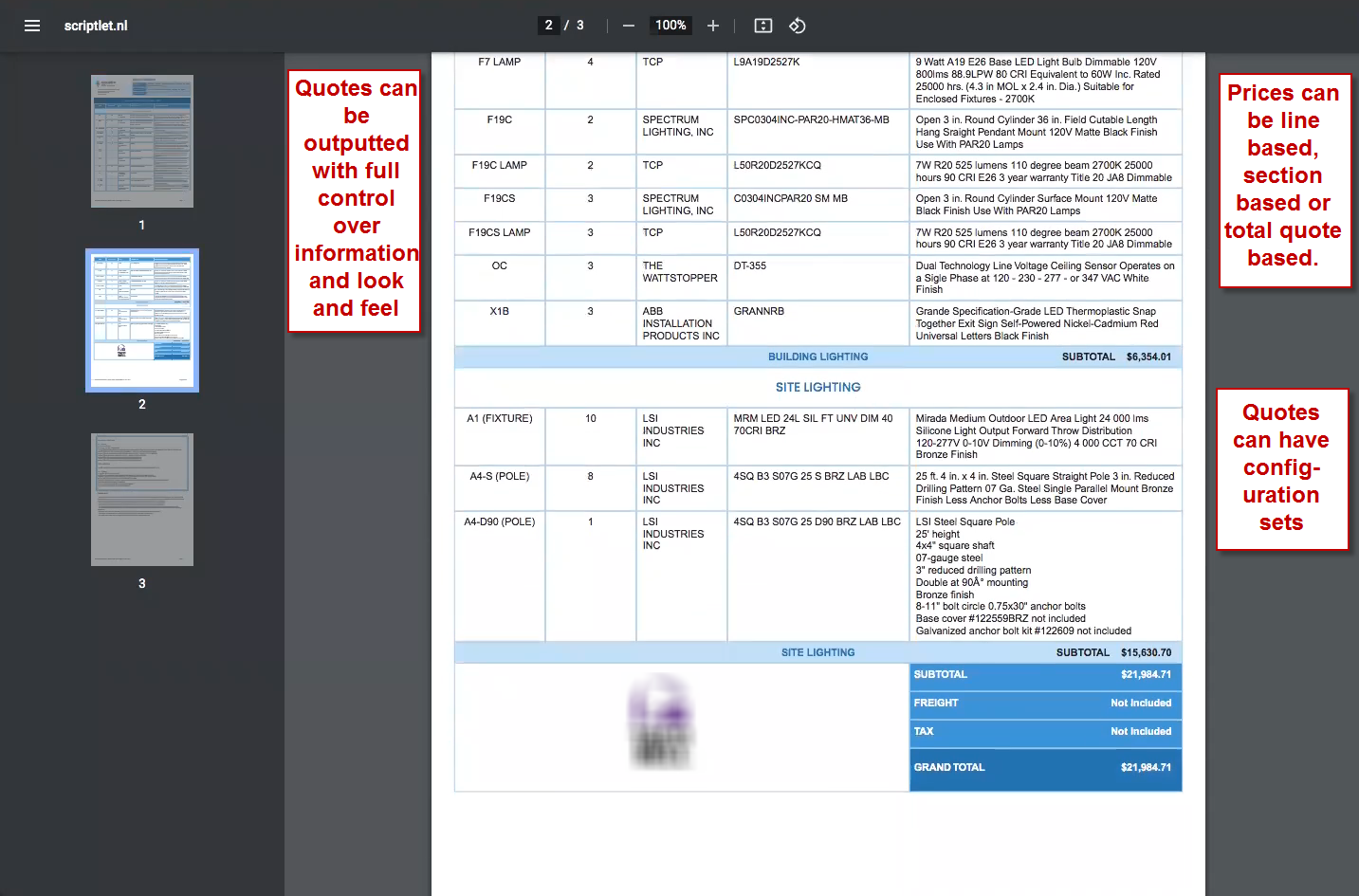
- Quote Expirations: Implementing expiration dates on quotes is a good practice, protecting suppliers from price erosion and encouraging timely customer decisions. A flexible database that is constantly updated through extensive quoting and automatic back-fill price table maintenance (meaning, the price tables are naturally updated as we work; we do not need to update prices separately) allows for quick repricing of existing proposals, accommodating fresh price considerations.
- Omitting Previous Quotes: In a complex quoting system where multiple quotes are issued, potentially to different parties, it’s vital to manage them effectively. Once a quote is accepted for a project, all other related quotes should be omitted or canceled to avoid duplication and confusion. However, the configuration data within these quotes remains valuable for future quoting on new projects.
These concepts are presented in the video below.
Watch Video Discussion and Demonstration (6:54)
As discussed, the following video is relevant after a viewer has watched earlier videos as discussed in the “2022” and “2023” article. Those articles present the foundation for the solution.
Click here to watch the video (6:54) directly.
Tailoring NetSuite for Complex Configuration-Oriented Supplier Sales
NetSuite’s platform shines in its adaptability to complex supplier configuration-oriented sales. Common sense suggests addressing intricate quoting requirements with spreadsheets. Who can be faulted; we need to get it done. Most people consider evolving from there by moving to a standalone proposal generator to mitigate the limitations of spreadsheets. However, the true potential lies in integrating business logic and data elements within a database-driven system, creating a cohesive and scalable solution.
NetSuite’s transaction system adeptly handles many distribution industry challenges. By attentively understanding specific business requirements, knowing the limitations of out-of-the-box capacities, utilizing NetSuite’s platform tools, and constructing robust logic, we can forge a path toward highly scalable sales operations. To get a return on investment requires both the willingness and competence to innovate.
Our client, dealing with catalogs encompassing millions of potential parts, is now able to maintain a lean NetSuite item database, only including necessary items for fulfillment. This approach retained flexibility in pricing and quoting, enabling rapid and controlled operations. Sales estimators collaborate with design engineers to create product sets, which project managers can ultimately deliver upon once receiving customer commitments. The reusability of configuration work saves time and enhances subsequent quoting processes, building momentum and a competitive edge; quoting is fast, flexible and trustworthy compared to the alternatives.
Understanding the intricacies of NetSuite’s core architecture and a keen ear for business concerns allows seasoned professionals to make impactful assessments and propose breakthrough business practices, efficiency, and effectiveness. Such wisdom is cultivated through careful stewardship in project scenarios and hands-on experience, leading to superior assessments and leadership narratives. In our assessment, we see too much disappointment in NetSuite outcomes — not because of the tool but because the modeling and guidance were subpar. The good news is that you can indeed optimize any NetSuite-driven situation with proper skills.
If this article resonates with you and you’re facing complex quoting challenges within NetSuite, lacking insight or visionary approaches, consider signing up for notifications on new articles or engaging in a conversation to explore these possibilities further.