


This article is relevant if you need to produce trustworthy actual margin in NetSuite and are deciding whether to reconstruct economic relationships from existing transactions or deliberately design the transaction model so those relationships are established when business events occur.
TL;DR Summary
Part 1 of this series showed how we can intelligently reconstruct actual margin from an inherited NetSuite account by following transaction lineage from Customer Invoice to Sales Order and then through fulfillment, procurement, Vendor Bills, and related costs.
That approach remains highly valuable. Yet new implementations and substantial optimization efforts give us a different opportunity. Instead of asking reporting to rediscover economic relationships later, we can consider whether NetSuite transactions should preserve those relationships as operations occur.
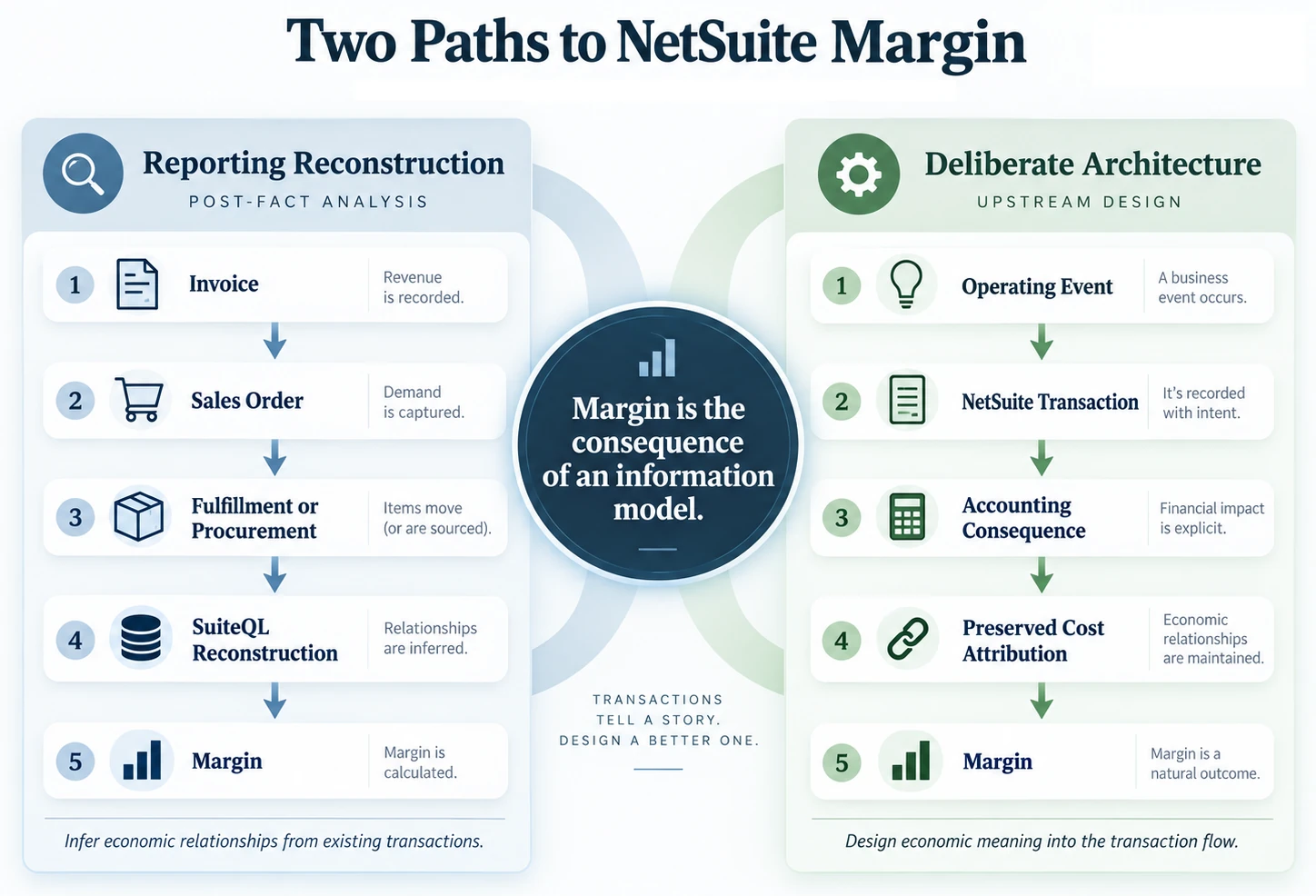
Margin is not fundamentally a report. Margin is the consequence of an intentional information model.
Background
In Part 1, Learn How to Reconstruct NetSuite Actual Margin for Sales Commissions, I described how our Operations Practice Leader, Hector Cardenas, developed a SuiteQL strategy to reconstruct margin from years of existing NetSuite history.
The method begins with Customer Invoice lines, traces back to the originating Sales Order lines, determines how each line was sourced, and then follows the appropriate cost path. Inventory items can lead through fulfillment and COGS. Drop-ship items can lead through created Purchase Orders, Vendor Bills, and identifiable freight or accessorial costs.
For an existing implementation, that can be exactly the right answer. It works with history, limits operational disruption, exposes assumptions and can cost materially less than redesigning transaction flows. It is expedient.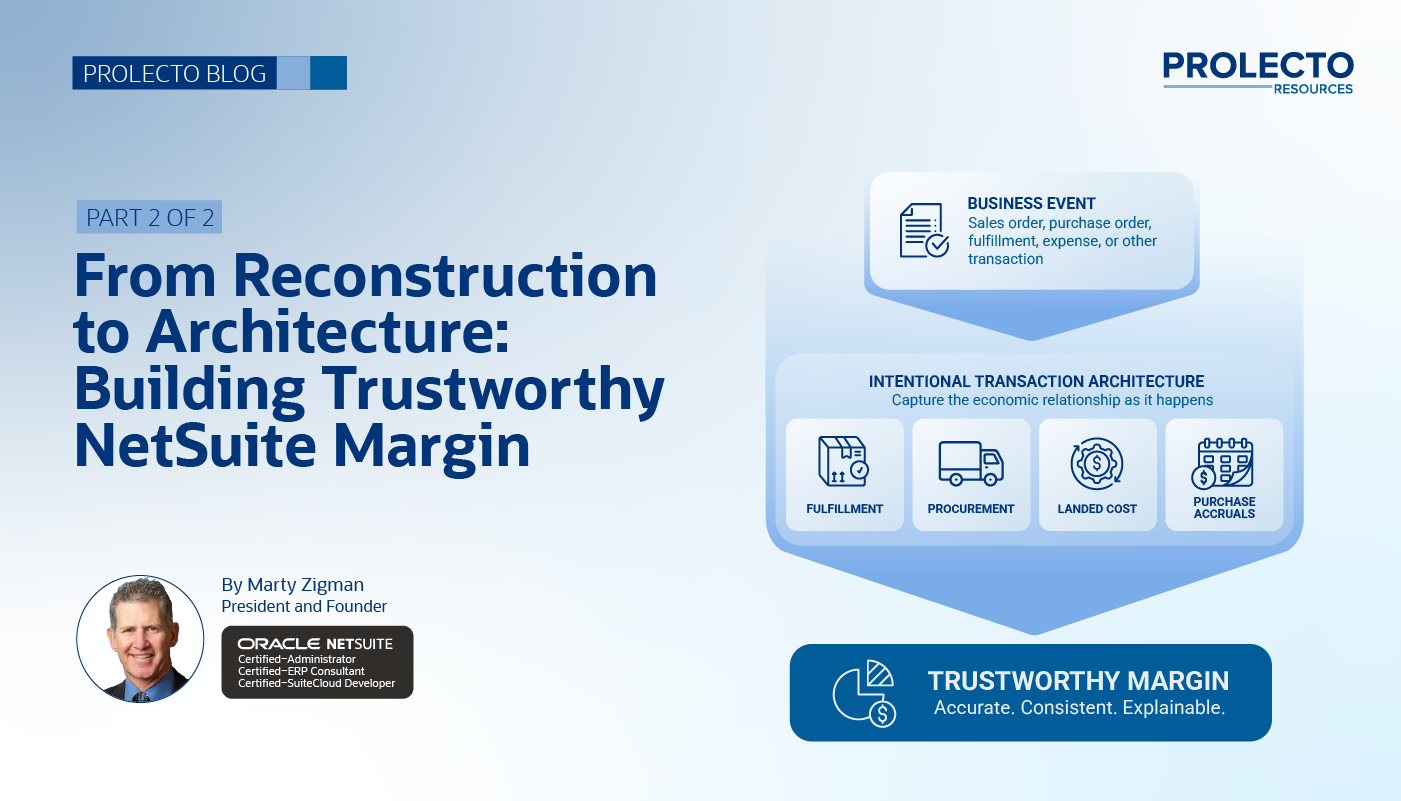
Yet Part 1 also raises the next question: if we were implementing NetSuite today, should we have needed to reconstruct these relationships?
Click the image to see it full size.
Why NetSuite Margin Begins With Transaction Architecture
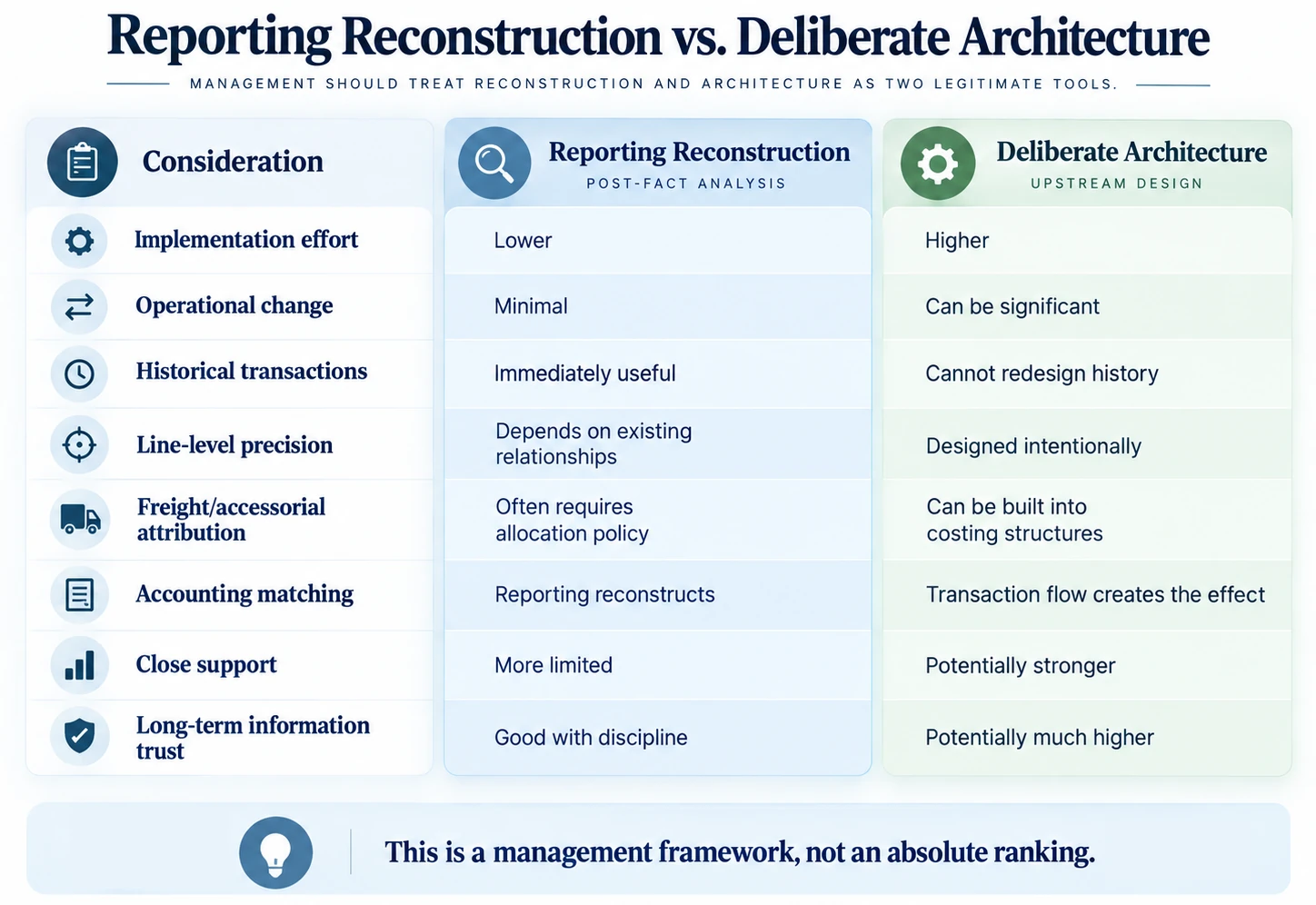
The distinction between the two approaches is straightforward.
Reporting reconstruction asks what happened. Architecture asks what should happen.
Reporting reconstruction examines the transactions we already have and asks whether we can infer the economic story from them.
In contrast, Architectural Design starts earlier. It asks what transaction structures should exist so the economic relationship is represented when the business event occurs. NetSuite is not preconfigured for this model.
This distinction matters because NetSuite transaction structures are flexible, but how you implement them has reporting and measurement implications. Operational lines, accounting lines, item fulfillments, item receipts, item references, and transaction links determine what you can later measure confidently. I explored this underlying issue over 10 years ago in my article, Mystery Solved: Multiple Lines on NetSuite Item Fulfillments and Receipts.
Management therefore has two legitimate tools (click image to see full screen).
This framework should not be read as an absolute ranking. A $20,000 problem may not justify a $100,000 redesign. Materiality, transaction volume, commission exposure, close complexity, audit requirements, operating stability, and organizational capacity for change all matter in decision-making.
Conversely, when margin informs salesperson compensation, pricing, purchasing, product management, forecasting, and financial reporting, a stronger information model can deliver substantial value.
Designing NetSuite So the Economics Appear Earlier
Our work on drop-ship accounting offers the most useful example.
A supplier may ship goods in one period while the Vendor Bill arrives in another. If cost recognition waits for Accounts Payable, customer revenue and the associated procurement cost may not (and frequently do not) match in the same economic period.
In my 2016 article, Solved: NetSuite Drop Ship Purchase Accruals and subsequent 2018 article, NetSuite DropShip Flows with Proper Accrual Accounting Demonstration, I pursued a different model.
The supplier shipment (property rights pass from seller to buyer) becomes an operational event that drives recognition. The Item Receipt produces the purchase accrual. Item Fulfillment produces COGS. Revenue and cost can occur in the proper economic period. The Vendor Bill later reconciles the accrued obligation.
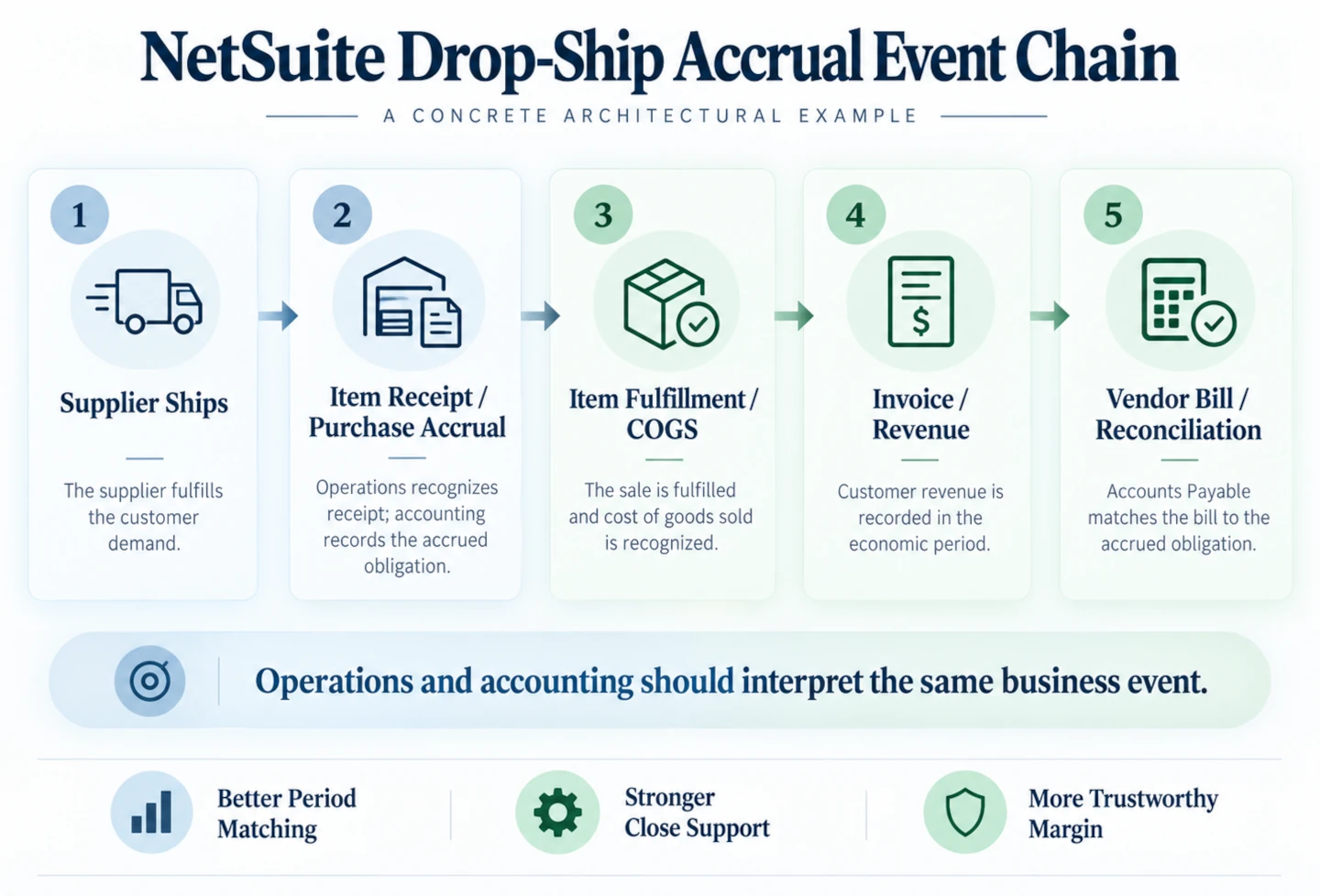
The bigger benefit isn’t simply better accounting. Operations says the supplier shipped. Accounting says an obligation and associated cost were incurred. Management says the sale generated revenue and economic cost. Accounts Payable later records the supplier’s invoice to coincide with the existing obligation.
Those views can reconcile because they originate from the same modeled event.
Moving Cost Attribution Upstream
Landed cost deepens the understanding of the example. Suppose a sale’s economics include $178.50 of product (PO line) cost, $35.00 of freight, and $48.00 of accessorial cost.
A reconstruction strategy can search for those amounts later and allocate them to a transaction. That may be perfectly reasonable under the right assumptions. A deliberate design instead asks management how freight, duty, brokerage, accessorial charges, and similar procurement costs should be represented when the transaction occurs. Where appropriate, those decisions can become landed-cost or accrual policy so COGS becomes a more useful economic fact. This fits a model called Inventory Capitalization under Generally Accepted Accounting Principles (GAAP).
This builds on considerations I discussed in my 2018 article, Learn how to Reliably Measure NetSuite Gross Profit and Margin and Understand NetSuite Shipping Revenue, Costs and Margin Review.
Architecture does not eliminate judgment. Management still must decide what margin means in its business model. Freight may belong. Commissions may or may not belong. Allocated overhead may belong in one management view but not another. Following GAAP imposes its point of view.
The architectural advantage is that those choices can become explicit system policy, applied consistently during operations, rather than assumptions independently rediscovered every time someone builds a report.
The best reporting logic cannot recover an economic relationship the transaction model never recorded.
Keep Commission Policy Downstream
Now, to stay aligned with Part 1 of our discussion, which had a client demand for commissions tracking, we need to reflect that commission calculations should consume economic facts rather than define them.
Operational Transactions → Revenue and Actual Cost → Margin → Commission Policy → Commission Obligation → Payment
This separation allows management to modify sales compensation policy without redefining the underlying economic truth. I explored the distinction in Drive NetSuite Commissions based on Cost Instead of Revenue.
The same modeling principle appears in project economics. Sometimes the economic thread management needs doesn’t naturally exist in standard transaction structures, so you must introduce it deliberately. See my 2021 article, Learn How To Measure NetSuite Project Margin.
Building NetSuite Information Trust Across the Organization
The ultimate goal is not sophisticated reporting. It is information trust.
Operations should be able to say, “We fulfilled the sale.” Purchasing should recognize which goods were supplied. Accounting should understand which period owns the cost. Management should see the resulting margin. Sales should understand the economic basis for commissions. This is what it looks like to fit NetSuite.
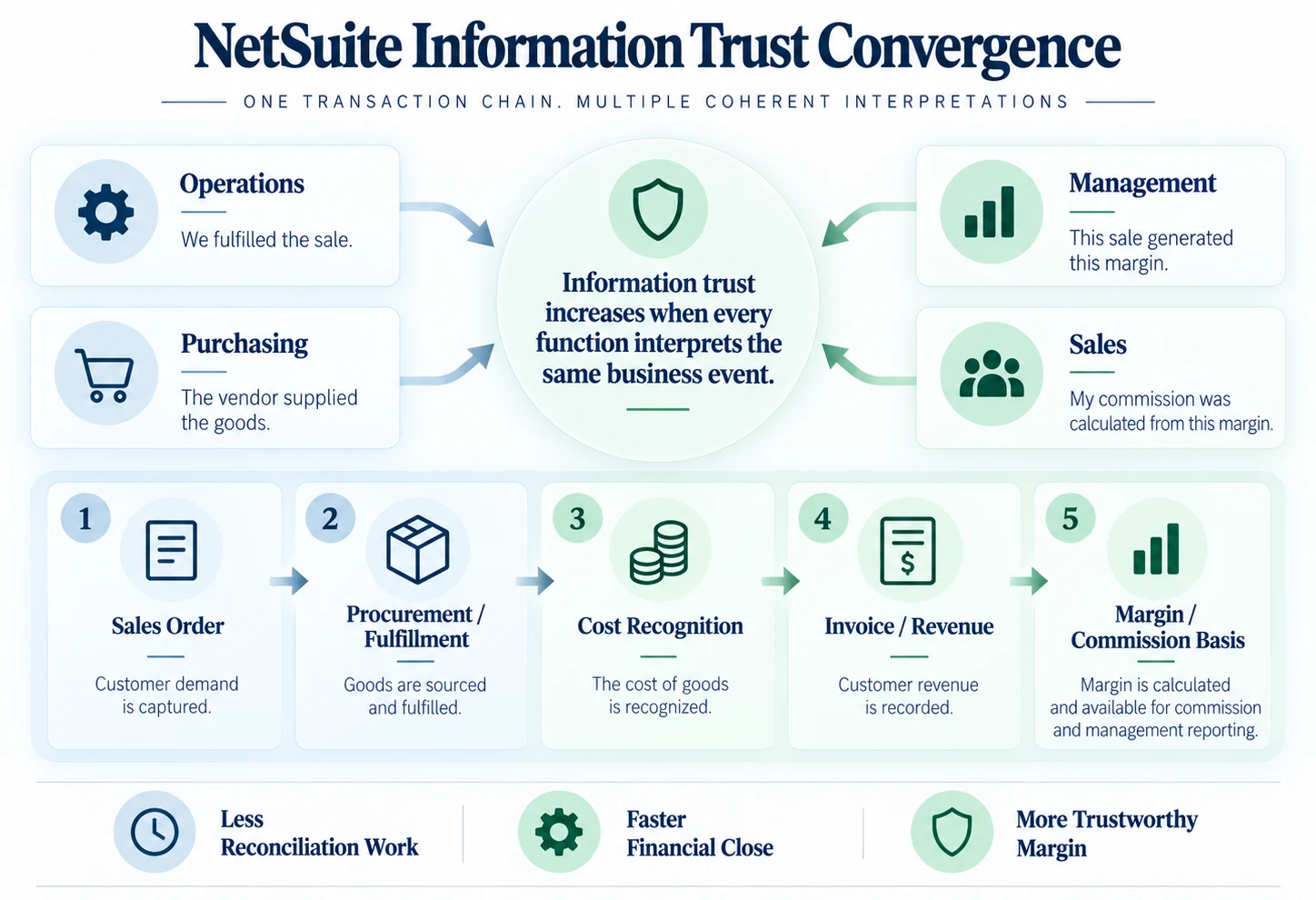
When those functions interpret the same transaction architecture coherently, the organization spends less time reconciling competing versions of reality. NetSuite’s potential finally begins to be unlocked.
This alignment also matters to the financial close. When operational events create the appropriate accruals and accounting consequences, Finance requires fewer manual period-end interpretations and catch-up adjustments. Simultaneously, good NetSuite architecture can consequentially improve operational effectiveness and financial close quality.
Creating a NetSuite Model Worth Trusting
For an existing implementation, our work often begins with what already exists. We listen to what management needs to know, inspect transaction relationships, determine what we can credibly reconstruct, expose assumptions, identify precision risks, and weigh the cost of reporting logic against the disruption of redesign.
A new implementation or substantial optimization gives us more freedom. We can ask what economic relationships should naturally be preserved and how procurement, fulfillment, landed cost, accruals, revenue, and accounting should fit together. This demands intentionality and architecture.
That kind of work requires listening, modeling, design, accounting understanding, and disciplined execution. It is also the kind of professional craft we seek to cultivate at Prolecto. We freely give our clients our existing intellectual property, algorithms, and solutions without a separate license charge because the enduring value is in the thinking and execution behind the model.
Part 1 demonstrated the power of understanding an inherited NetSuite environment deeply enough to reconstruct a credible economic story.
Part 2, this article, points to the larger opportunity. Where the investment is justified, we can fit NetSuite so that economic story is written correctly when the transaction occurs.
If you found this article relevant, feel free to sign up for notifications to new articles as I post them. If you are ready to determine whether your NetSuite margin challenge calls for better reporting or a stronger transaction architecture, let’s have a conversation.