


This article is relevant if you are a CIO, CFO, Controller or NetSuite administrator whose Oracle NetSuite ACS renewal is approaching and you want to understand your options before you sign another contract period.
TL;DR Summary
Oracle NetSuite sells three distinct layers of help: Base Support (Basic or Premium), which fixes the platform; Advanced Customer Support (ACS), which sells hours of guidance and configuration help; and Professional Services, which does projects. Letting ACS lapse does not affect the first base layer. The real question to contemplate at renewal is who will know your business well enough to keep NetSuite aligned with it. Below I explain what each layer includes, the four realistic options when ACS ends, how they compare, who should keep ACS, and a transition checklist to work through before your renewal date.
Background
Over the last few years, conversations with prospective clients may start the same way: “Our ACS contract is up for renewal, and we are not sure we are getting enough value from it.”
I want to be careful here. ACS is a legitimate Oracle offering staffed by capable people, and it fits some organizations well. Yet when I listen to clients who struggle with the model, I usually hear three things. The hours went unused. The people understood NetSuite, but not always the business nuance behind the request, making the work harder than it should be. Or the issue that mattered most, often involving accounting, an integration or a third-party SuiteApp, fell outside what ACS would do.
Prolecto has worked exclusively with NetSuite since 2008 and has served more than 500 clients. Our model is intentionally independent. We do not resell NetSuite licenses, and we are not built around creating ongoing commercial obligations for clients. We prefer relationships where the work stands on its own, the client retains flexibility, and continued engagement is earned through performance and trust.
What is NetSuite ACS, and what do Basic and Premium Support already include?
It helps to separate the three layers, because they are frequently confused, sometimes in partner marketing.
NetSuite Support (Basic or Premium) is how Oracle fixes the platform. You open a case when something is broken: an outage, a defect, a feature not behaving as documented. Under Oracle’s published Support Terms:
- Basic Support includes 24×7 coverage for Severity 1 (critical) issues with a two-hour response target, and allows two authorized support contacts.
- Premium Support is a paid upgrade. It shortens the Severity 1 target to one hour, extends 24×7 coverage to Severity 2, adds response targets for Severity 3 and 4 issues, and allows four authorized contacts.
Advanced Customer Support (ACS) is not break-fix support. It is a subscription to hours of guidance, reviews and hands-on configuration help from Oracle’s team. NetSuite now markets it as “NetSuite Managed Services.” As of Oracle’s September 15, 2026 Service Descriptions, the current tiers are ACS Advise, ACS Monitor 36, ACS Optimize 20 and ACS Architect 40, with optional “Extended Service” hours billed in arrears. A few terms matter at renewal:
- Unused hours are forfeited at the end of each month or quarter, with no refunds or credits.
- Optimize and Architect require Premium Support under a separate contract.
- Oracle is not responsible for configuration, development or testing on third-party applications and may decline requests it judges out of scope or too large.
- You own user acceptance testing and sign-off.
- Pricing is not published; it is set on your order form.
Professional Services is project statement of work driven: implementations, module activations, larger builds.
Is ACS required?
No. ACS is an optional add-on. Your NetSuite subscription, your data and your Support entitlement do not depend on it.
What happens if we let our NetSuite ACS contract expire?
Practically, three things:
- Your account keeps running: Nothing in NetSuite changes on the expiration date.
- Platform problems still go to Oracle: Outages and defects continue to be handled through NetSuite Support, at whatever level you hold.
- You lose the hours and the reviews: Scheduled ACS check-ins, health reviews and configuration hours stop, along with your named Oracle contact.
One consideration: if you are on Optimize or Architect, you bought Premium Support because ACS required it. When ACS goes, some finance teams cut Premium at the same time to capture the full savings. Make that a separate, deliberate decision.
Who handles bugs and outages if we cancel ACS?
Oracle does, through NetSuite Support, exactly as before. ACS was never the channel for platform defects.
What changes is who sits between your users and Oracle. Somebody needs to recognize that a problem is a platform defect rather than a configuration or script issue, reproduce it, and open a well-documented case. That somebody should be one of your authorized support contacts.
When Prolecto supports a client, our team diagnoses first, resolves what it can within the account, and prepares the evidence for an Oracle Support case when the defect is genuinely Oracle’s. Plan your authorized contacts with your partner in mind.
What are the best alternatives to Oracle NetSuite ACS?
There are four realistic paths. They are not mutually exclusive.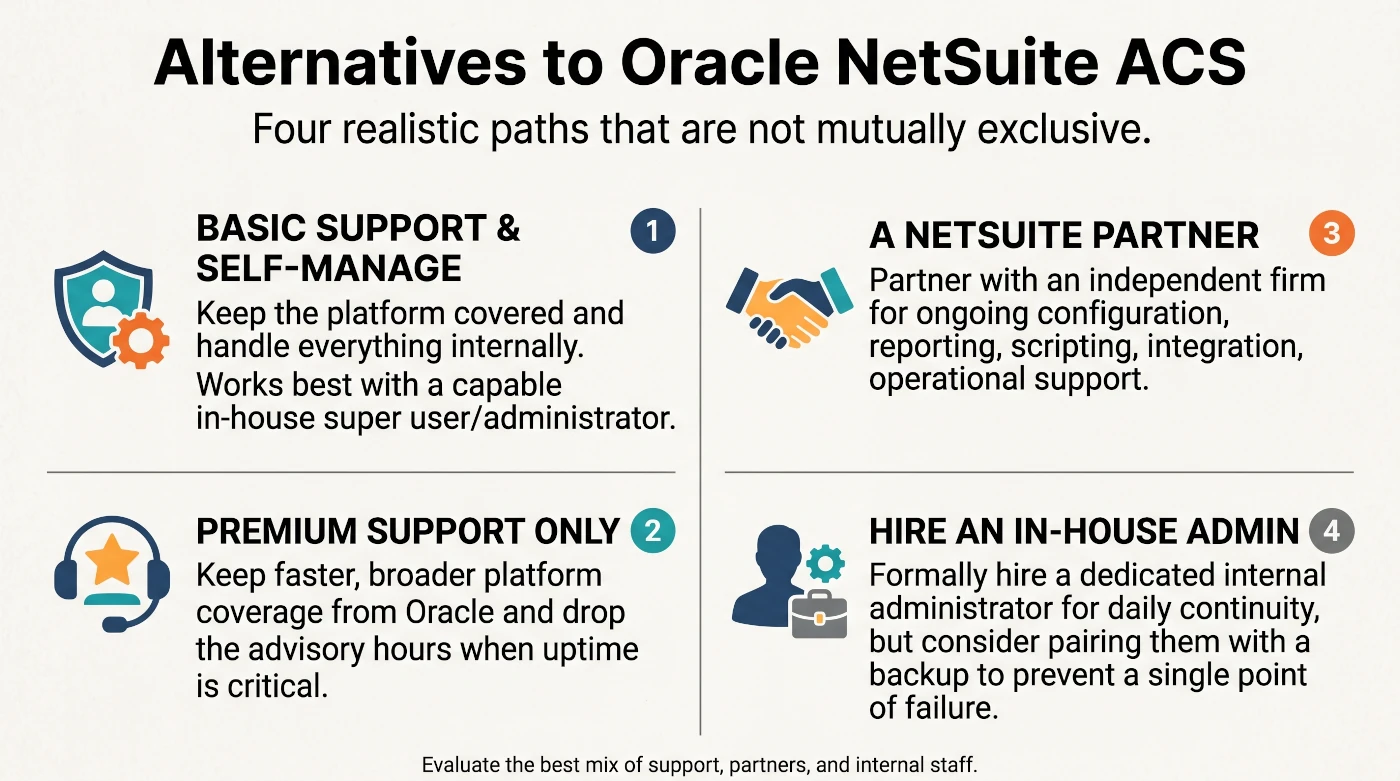
- Basic Support and self-manage: Keep the platform covered and handle everything else internally. This works for accounts with a capable super user (sometimes called casually the NetSuite Administrator; see below).
- Premium Support only: Keep faster, broader platform coverage from Oracle and drop the advisory hours when uptime is critical.
- A NetSuite partner on an ongoing relationship: An independent firm that knows your account carries the configuration, reporting, scripting, integration and operational/accounting work. One strategy is to run partners alongside ACS for a period so you can compare before you decide.
- Formally hire an in-house NetSuite administrator: Hire your own person. This gives you daily continuity, but it is a single point of failure, and one administrator rarely spans accounting, operations and development. Many of our clients pair an internal administrator with Prolecto as their senior backup — this provides quality coverage for any type of concern.
How do the options compare?
| Basic Support + self-manage | Premium Support | Oracle ACS | Partner relationship (e.g., Prolecto) | In-house administrator | |
|---|---|---|---|---|---|
| What it fixes | Platform defects | Platform defects, faster | Guidance and configuration within Oracle’s scope | Your business processes in NetSuite: configuration, reports, scripts, integrations, accounting | Day-to-day administration subject to individual’s skills |
| Cost model | Included as a line on the subscription | Paid upgrade on top of subscription | Annual subscription by tier; unused hours forfeited | Varies by partner; Prolecto’s model is based on earned efforts. | Salary and benefits |
| Who does the work | Your team | Your team; Oracle on platform cases | Oracle’s ACS team, with your team testing | Varies; Prolecto has named client advocate | Your employee |
| Third-party SuiteApps and integrations | You | You | Out of scope | Varies but typically in scope | Depends on the person |
| Accounting depth | You | You | Product guidance | Varies; Prolecto has a CPA-led accounting practice | Depends on the person |
| Continuity risk | Impersonal; low risk | Impersonal; low risk | Contact may rotate | Low if the team is stable | High if one person leaves |
Why do companies leave ACS at renewal, and who should keep it?
The companies I see leave ACS tend to share a pattern. Their needs are specific to their business, not to the product. They need someone to rework revenue recognition, reconstruct actual margin for commissions, untangle an integration, or plan for Oracle’s SuiteScript 2.1 deadline. Product guidance alone does not get those done. They also want the same people every time, and they want to pay for outcomes rather than for hours that expire.
There are organizations where ACS makes good sense. If the NetSuite account remains relatively standard, the internal team carries most of the responsibility, and Oracle provides periodic guidance, ACS can fit well. The same may be true where procurement or governance favors a single-vendor relationship. The challenge tends to appear as the account becomes more distinctive, where the business model, accounting, integrations and customizations demand broader context and deeper continuity.
How does ACS cost compare with a partner retainer?
Oracle does not publish ACS prices, so make the comparison with your own contract. Consider the following approach:
- Take your annual ACS fee.
- Divide it by the hours you actually used last year, not the hours included. That is your effective hourly rate. At 60% utilization, you are paying roughly 1.67 times the nominal rate.
- Contemplate the requests ACS declined or that you never sent because they were out of scope. Those costs went somewhere else: internal overtime, another consultant, or a problem left unsolved.
- Consider the satisfaction of the experience as a qualitative concern.
Then compare that against a partner proposal for the same work. Ask any partner the same question you would ask Oracle: what happens to hours I do not use? Some partner retainers have the same use-it-or-lose-it economics. Our Prolecto model works differently. We produce roadmaps to define the ambition, then separate project work from ongoing support and adjust that mix as the relationship develops. The structure should follow the work that is actually needed, not force the client into a fixed consumption pattern. Ultimately, we earn fees through useful work and continued trust.
How does Prolecto’s ongoing support work?
We are not a one-and-done project firm. Most of our client relationships last years, and the same cycle (listening, conceiving, modeling, designing, fitting, activating, and refining) guides our project work and how we approach support. We help clients shape and advance what comes next. Management runs the business, with our team close by as needs evolve.
- A dedicated client advocate: We assign a professional who learns the account, understands the relationship, and stays close to the work. That person may attempt to solve concerns immediately but is not expected to have every answer. Their role is to bring the right senior people and practice leaders into the conversation so they understand concerns, make thoughtful decisions, and keep the client well cared for.
- Accounting is native to us: I started my career as a CPA at Deloitte & Touche, and our Accounting practice works on revenue recognition, multi-book, consolidation and close. That is where generic support most often falls short.
- License-free intellectual property: Clients receive access to our library of 76 (at the time of this writing) accelerator templates and our code modules with no license fees. When we build something for you, it lives openly in your account.
- Technology leadership: We have built substantial technical depth inside the firm and keep the work there. We do not outsource implementation challenges to others. Our people solve them directly, which is why we frequently build new tools, extend the platform, and turn what we learn into the intellectual property behind our Accelerator Templates.
- We run on NetSuite ourselves: We use Prolecto Ticket Manager for ticketing, built on native NetSuite support cases, so requests, history and decisions stay visible and organized.
- We look ahead: Oracle has set NetSuite 2028.2 as the release when legacy scripts stop running. We built the Prolecto Script Upgrade Planner to help clients measure that exposure and plan for it. Forward-looking work like this is what an ongoing relationship should provide. See my recent article, When NetSuite Technical Debt Comes Due: Planning the SuiteScript 2.1 Transition.
Can we switch when there is already a backlog of open concerns?
Yes, but give the new team time to understand the account before expecting them to resolve everything already in motion. Some concerns may benefit from a fresh set of eyes, while others will make more sense once the history and business context are understood. Prolecto prefers to begin with a fresh sandbox so we can work safely without inheriting unnecessary uncertainty. If the objective is broader optimization, we may first undertake a Roadmap effort, which often shifts priorities as we develop a better understanding of the account. The key is to distinguish transition work from solution work and give the new team enough time to get up to speed before asking it to make consequential decisions.
Transition checklist: before your ACS renewal date
Start at least one quarter before renewal.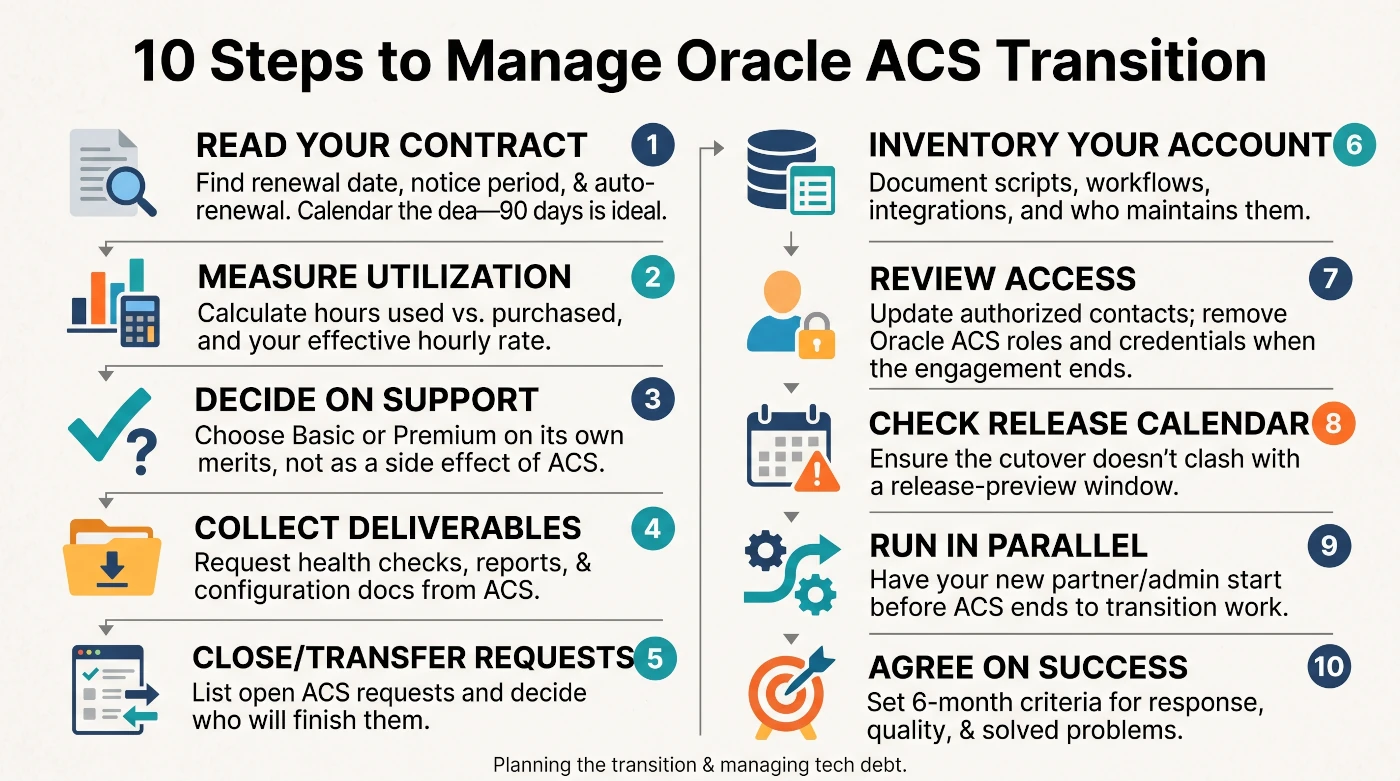
- Read your contract/order form: Find the renewal date, the notice period and any auto-renewal clause. Calendar the notice deadline. 90 days is often the right window so you have time to act and for Oracle to respond.
- Measure utilization: Calculate hours used against hours purchased for the last twelve months, and your effective hourly rate.
- Decide on Support separately: Choose Basic or Premium on its own merits, not as a side effect of canceling ACS.
- Collect ACS deliverables: Request copies of health checks, review reports, recommendations and any configuration documentation ACS produced. These will be valuable for any new support relationship.
- Close or transfer open requests: Enumerate open ACS requests and decide who will finish each one.
- Inventory your account: Document scripts, workflows, integrations and installed SuiteApps, and note who maintains each. This is also the start of your SuiteScript 2.1 plan. Read my recent article, When NetSuite Technical Debt Comes Due: Planning the SuiteScript 2.1 Transition, for a free analysis tool to help you get organized.
- Review access: Update authorized support contacts, and remove Oracle ACS roles and credentials when the engagement ends.
- Check the release calendar: If you are regression testing, make sure the cutover does not fall in the middle of a release-preview window.
- Run in parallel: Contemplate your new partner or administrator starting before ACS ends, with a short list of real work so that you keep options open.
- Agree how you will judge success: Develop criteria for what good looks like in six months: response, quality, and the business problems you expect to be solved.
Frequently Asked Questions
What happens if we let our NetSuite ACS contract expire?
Your account keeps running, and Oracle still handles platform defects through NetSuite Support. You lose the remaining ACS hours, the scheduled reviews and your named ACS contact.
Is NetSuite ACS required?
No. ACS is an optional subscription. Your license and support entitlement do not depend on it.
What is the difference between Basic Support, Premium Support and ACS?
Basic and Premium Support fix the platform. Premium responds faster and covers more severities around the clock. ACS sells hours of guidance and configuration help, and its Optimize and Architect tiers require Premium Support.
What are the best alternatives to Oracle NetSuite ACS?
The main alternatives are Basic Support with internal management, Premium Support alone, an ongoing relationship with an independent NetSuite partner, or an in-house administrator. Many companies combine an internal administrator with a partner.
How does ACS cost compare with a partner retainer?
Divide your annual ACS fee by the hours you actually used to find your effective rate, then compare it with partner proposals for the same work. Ask every provider what happens to unused hours. Consider the experience and depth of the professionals.
Who handles bugs and outages if we cancel ACS?
Oracle, through NetSuite Support, as before. Your partner or administrator diagnoses issues first and opens well-documented cases with Oracle when the defect is in the platform.
Can we switch mid-release cycle?
Yes. Either have your new team start before the release-preview window opens, or keep ACS through the upgrade and cut over after it.
If you found this article relevant, feel free to sign up for notifications to new articles as I post them. If your ACS renewal is approaching and you want an independent view of your options, let’s have a conversation.
Sources
- Oracle NetSuite ACS Service Descriptions, effective September 15, 2026: https://www.oracle.com/apac/a/ocom/docs/oracle-netsuite-acs-service-descriptions-us-eng.pdf
- Oracle Support Terms for NetSuite cloud services: https://oracle.com/cn/a/ocom/docs/cloud-nsgbu-support-terms-for-oracle-cloud-services.pdf
- NetSuite, “Which Level of Support is Right for Your NetSuite Solution?”: https://www.netsuite.com/portal/resource/articles/erp/which-level-of-support-is-right-for-your-netsuite-solution.shtml